

Problem

The basic grade level structure. The combiner batches students into classrooms based on either a prescribed or dynamic student teacher ratio. They are joined by a district rule. The parent entity is the teacher which is then assigned the students district. At the end of the school year, the batch is separated and students either recycle the grade level or move to another module.
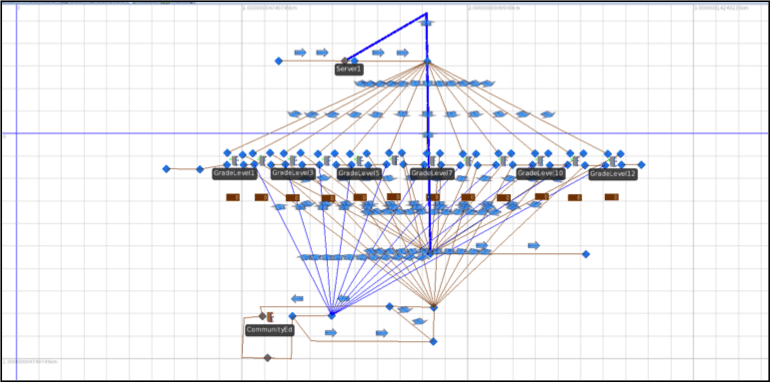
The education module is the aggregation of 12 grade levels and the community education. Blue student paths allow students to return to the respective grade level after completing community education, whereas brown student paths connect sequential grade levels to one another and to community education. The bold blue path brings teachers back to the teacher pool for reassignment at the end of each school year.
This work introduces a novel application of a SIMIO Discrete Event Simulation (DES) which uses entities that are analogous with primitive agents to provide key insights for the international educational planner. DES has become a common analytic tool in policy decision making and is widely used in areas such as emergency services, healthcare management, and military procurement. However, there is an apparent gap regarding the use of such simulation analysis in education planning.
Afghanistan has only a 27% literacy rate, and in much of the country security and culture prevent millions of children from attending school. Recently, the international community has dedicated substantial resources to improve Afghan education. The use of simulation to inform decisions will not only help, but should often be compulsory before dedicating limited resources to such a complex system.
Here we introduce a principal simulation model in which individual students and teachers interact within the Afghanistan Education System across a variable time horizon. This allows education planners and policy makers to gain insight into the implications of security, policy, and infrastructure in this complex environment.
Solution
Benjamin Marlin and Hansuk Sohn at Industrial Engineering in New Mexico State University used SIMIO to assess the potential futures of the Afghanistan Education System. By adopting multiple large-scale designs of experiment, applying social impact theory, and approaching the problem at the provincial level, a high-resolution representation of the system was built.
Student and teacher entities which communicate and make simple decisions as they flow through the education system were created. These entities are influenced by both exogenous factors (such as attacks on schools) and endogenous factors (such as teacher production), including security, funding, and resolve. Through the simulation model, educational planners are able to better understand this complex environment.
Result

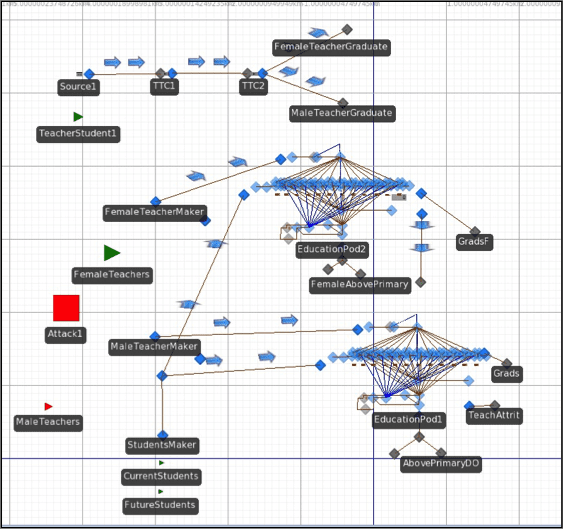
The results of the simulation provided extensive information concerning the growth of literacy, graduation rates, quality of education, parity across genders and social groups, and geographic location. Specific provinces of concern and potential scenarios that could cause system failures were identified.
Policy options such as community-based education, multigrade classrooms, and information operations were shown to significantly influence education outcomes in Afghanistan. As a proof of principle, this project demonstrates the benefit of using complex simulation in education planning.
This project was a major portion of Benjamin’s PhD dissertation under Dr. Hansuk Sohn’s supervision.