Discrete Event Simulation Software: Simulate What-If with an Intelligent Digital Twin
Time-tested and proven, the Simio Discrete Event Simulation Software Platform delivers unmatched versatility and capabilities for simulating what-if scenarios with intelligent digital twins to solve complex operational challenges.
What is Discrete Event Simulation?
Discrete event simulation allows organizations to model complex systems where state changes occur at specific points in time. Discrete event simulation focuses on the specific moments when changes happen in a system – such as a customer arrival, a machine breakdown, or a process completion.
With Simio’s approach, discrete event simulation becomes more powerful through the integration, becoming true intelligent digital twins. This evolution enables organizations to not only model their systems but also connect these models to real-time operational data, creating a dynamic virtual replica that evolves alongside physical operations.
Discrete event simulation is particularly effective for:
- Greenfield Projects: Model new facilities, processes, or systems
- Brownfield Analysis: Analyze modifications to existing operations
- Variability Management: Understand and mitigate the impact of variability
- Resource Optimization: Optimize resource allocation and system configurations
- Performance Enhancement: Improve overall system performance and efficiency
The foundation of discrete event simulation lies in its ability to represent entities (products, customers, documents) flowing through a process while interacting with resources (equipment, personnel, space) according to defined logic. When enhanced with digital twin technology, discrete event simulation transforms from an analysis tool into a continuous operational asset that provides ongoing value through real-time insights and what-if analysis capabilities.
The Intelligent Digital Twin Approach
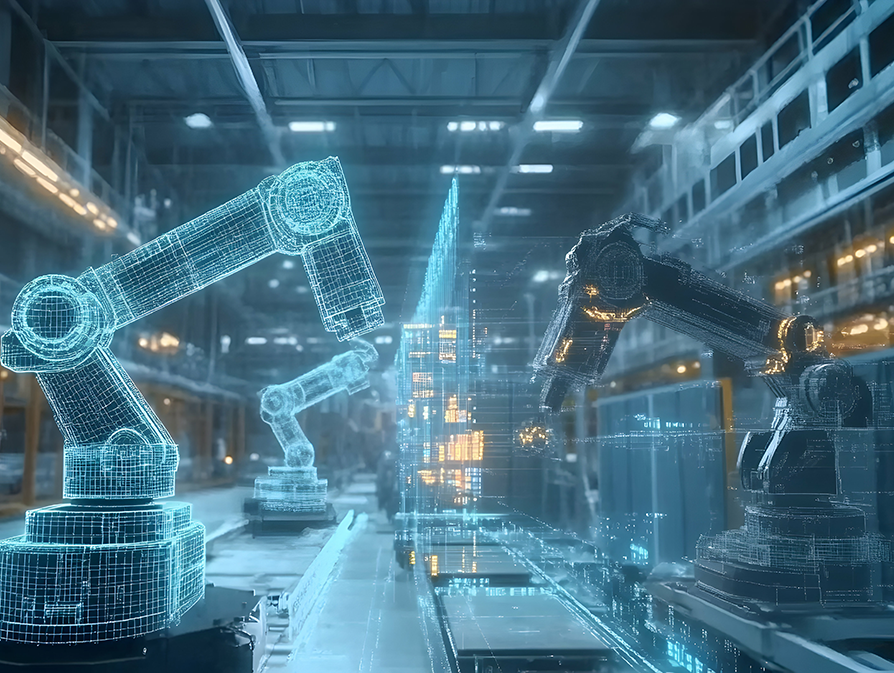
Digital twin technology bridges the gap between physical operations and virtual modeling through continuous data integration. What makes Simio’s digital twins truly intelligent is the native, embedded support for Neural Networks and AI capabilities—the first Discrete-Event-Based Digital Twin Simulation software to offer this level of integration directly within its simulation engine. This intelligence enables dynamic scenario generation, self-calibrating models, and automated decision support that transform traditional simulation from static analysis to continuous optimization.
Simio’s intelligent digital twins incorporate embedded AI agents that capture complex decision logic, by generating synthetic training data for AI model development powered by TensorFlow. The platform allows organizations to test and validate AI algorithms in a risk-free virtual environment before implementation, while its seamless Python integration enables data scientists to leverage familiar tools to further optimize decision making and optimization using Simio’s powerful simulation engine.
How Digital Twins Enhance Discrete Event Simulation
Traditional discrete event simulation models provide valuable insights, but intelligent digital twins take this capability to the next level. By creating a virtual replica of physical systems that updates in real-time, digital twins enable more dynamic and accurate what-if analysis.
Traditional Discrete Event Simulation
- Static data inputs
- Manual scenario setup
- Point-in-time analysis
- Limited integration
Intelligent Digital Twin Discrete Event Simulation
- Real-time data integration
- AI-driven scenario generation
- Continuous monitoring and adaptation
- Connected to IoT, ERP, and other systems
A process digital twin provides unprecedented visibility into your operations by mirroring real-world processes in a virtual environment. This approach allows you to:
- Emulate system performance: Monitor current operations in near-real-time through synchronized digital representation
- Identify emerging bottlenecks: Pinpoint constraints and inefficiencies as they develop within the operational system
- Test solution scenarios: Evaluate potential improvements before physical implementation in a risk-free virtual environment
- Predict operational behavior: Forecast future system performance based on current conditions and historical patterns
- Enable continuous optimization: Improve operations on an ongoing basis rather than through periodic interventions
Through what-if analysis simulation, teams can test multiple scenarios without disrupting actual operations. This capability is particularly valuable when evaluating potential changes to existing systems or designing entirely new processes.
Benefits of Simio’s Approach

Visualize & Understand the System
- Create accurate, dynamic models: Develop comprehensive models that capture all operational rules and decision logic for complete system representation
- Enable stakeholder visualization: Provide clear visual interfaces that help all stakeholders understand complex process parameters and system behaviors
- Utilize 3D animation: Communicate system behavior effectively through interactive 3D visualization that reveals operational dynamics
- Build shared understanding: Establish a common operational perspective across teams by creating visual models of current and proposed operations
- Identify improvement opportunities: Enhance visibility into system performance to uncover optimization potential through comprehensive digital visualization
Digital twin simulation creates a virtual replica of your physical systems that updates in real-time with operational data. This visual representation helps teams develop a shared understanding of how systems work and where improvements can be made.
Reduce New Implementation Risks
- Test designs virtually: Evaluate new designs and processes in a risk-free digital environment before physical implementation begins
- Identify potential issues: Discover and resolve operational challenges before they impact actual systems
- Quantify expected benefits: Calculate precise performance improvements from proposed changes through detailed simulation results
- Build stakeholder confidence: Develop trust in implementation decisions through visual demonstrations of expected outcomes
- Reduce implementation costs: Minimize the time and financial resources associated with system implementation through simulation-based validation
Simulation software like Simio helps mitigate implementation risks by allowing you to test changes in a virtual environment first. The benefits of a simulation-based digital twin include improved decision-making, reduced operational risks, and optimized performance.

Analyze & Optimize Performance
- Measure key performance indicators: Track critical KPIs across multiple scenarios to identify optimal configurations
- Identify system bottlenecks: Locate constraints that limit overall system performance through detailed simulation analysis
- Test improvement ideas: Evaluate potential enhancements in a risk-free virtual environment before implementation
- Optimize resource allocation: Maximize utilization of critical resources through data-driven simulation insights
- Evaluate objective trade-offs: Balance competing priorities by understanding performance impacts across different scenarios
Through what-if analysis simulation, teams can test multiple scenarios without disrupting actual operations. This capability allows for continuous improvement based on data-driven insights rather than intuition or guesswork.

Evaluate & Analyze Alternatives
- Compare design alternatives: Objectively assess multiple design options through consistent performance metrics
- Quantify performance differences: Measure precise operational variations between competing configuration options
- Understand sensitivity factors: Determine how results respond to changes in key assumptions and input parameters
- Make data-driven decisions: Select optimal configurations based on comprehensive simulation results
- Document selection rationale: Create clear records explaining the evidence-based reasoning behind chosen alternatives
By implementing a digital twin, organizations can evaluate alternatives with current operational data, ensuring decisions are based on the most up-to-date information available.
Improve System Design & CapEx Deployment
- Optimize facility layouts: Design efficient process flows and physical arrangements through simulation testing
- Right-size equipment and staffing: Determine optimal resource levels based on simulated operational demands
- Validate design requirements: Confirm that proposed designs will meet performance specifications before implementation
- Maximize capital investment returns: Ensure the highest possible ROI on infrastructure and equipment investments
- Avoid unnecessary expenditures: Prevent over-engineering and excessive spending through evidence-based decision making
A Simio intelligent digital twin combines simulation capabilities with AI to enable predictive analysis and autonomous optimization. This approach ensures that new system designs are not only effective at launch but can also adapt to changing conditions over time.
Understand the Impact of Variation
- Model realistic variation: Represent actual system variability using appropriate statistical distributions
- Analyze performance effects: Quantify how operational variation influences overall system performance
- Identify critical variation sources: Determine which sources of variability have the most significant impact on results
- Develop mitigation strategies: Create approaches to minimize the negative effects of unavoidable system variation
- Build robust operational systems: Design processes that perform effectively despite inherent uncertainty and variability
When comparing digital twin vs simulation approaches, the key difference lies in how they handle real-time data integration and associated model adaptation. While traditional simulation uses historical data and statistical distributions, digital twins incorporate live data feeds to create and adapt simulation models automatically that reflect current conditions more accurately.
Continuously Explore Process Improvements
- Create virtual testing environments: Establish digital sandboxes for evaluating improvement ideas without operational disruption
- Engage stakeholders in optimization: Involve cross-functional teams in the improvement process through interactive simulation
- Quantify improvement benefits: Calculate expected performance gains from proposed process enhancements
- Prioritize improvement initiatives: Rank potential improvements based on their simulated value and implementation feasibility
- Implement changes confidently: Execute process modifications with certainty based on comprehensive simulation validation
By deploying digital twin technology, organizations enable ongoing optimization as conditions change, creating a continuous improvement cycle driven by real-time data, AI and advanced analytics.
Why Simio for Discrete Event Simulation?
With over 46 years of industry-leading simulation technology development experience, Simio represents the most innovative simulation software available today. Our team has continuously advanced the science of Discrete Event Simulation, creating a fourth-generation architecture that combines ease of use with unprecedented flexibility, power, and speed.
Simio’s platform is built from the ground up—not simply an adaptation of existing applications—delivering robust, scalable simulation capabilities with seamless third-party integration. This architecture excels in both functionality depth and handling complex models, making it ideal for digital twin implementations. Simio masters traditional simulation tasks while replacing legacy applications that struggle with challenging operational needs like Advanced Planning and Scheduling (APS).
Our user-friendly, feature-rich platform supports your journey from beginner to expert, backed by our customer-focused team offering specialized knowledge and extensive support resources to ensure your success with both simulation and intelligent digital twins.
Simio: The Best Choice for Simulation

Intuitive Modeling Experience
Simio provides a powerful yet intuitive modeling environment that combines traditional point-and-click interfaces with advanced data-generated and data-driven approaches for developing intelligent digital twins. The platform features drag-and-drop model building requiring no programming, while supporting rapid development through configurable object libraries and application-specific templates.
Key capabilities include:
- Data-generated modeling: Simplifies complex modeling scenarios and scales to multi-site applications
- Out-of-the-box intelligent objects: Reduces ramp-up time for new users through ready-to-use object libraries
- Hierarchical design structure: Allows models to be instantiated as objects within other models
- Industry-specific templates: Provides predefined objects, process logic, and data schemas
- NVIDIA Omniverse integration: Enables enhanced visualization and collaborative model development
- Extensive CAD compatibility: Supports systems including SketchUp, AutoCAD, Inventor, and SOLIDWORKS
Simio’s intuitive interface makes powerful digital twin technology accessible to both simulation experts and those new to modeling, enabling broader adoption across organizations while minimizing long-term support requirements.

3D Visualization & Animation
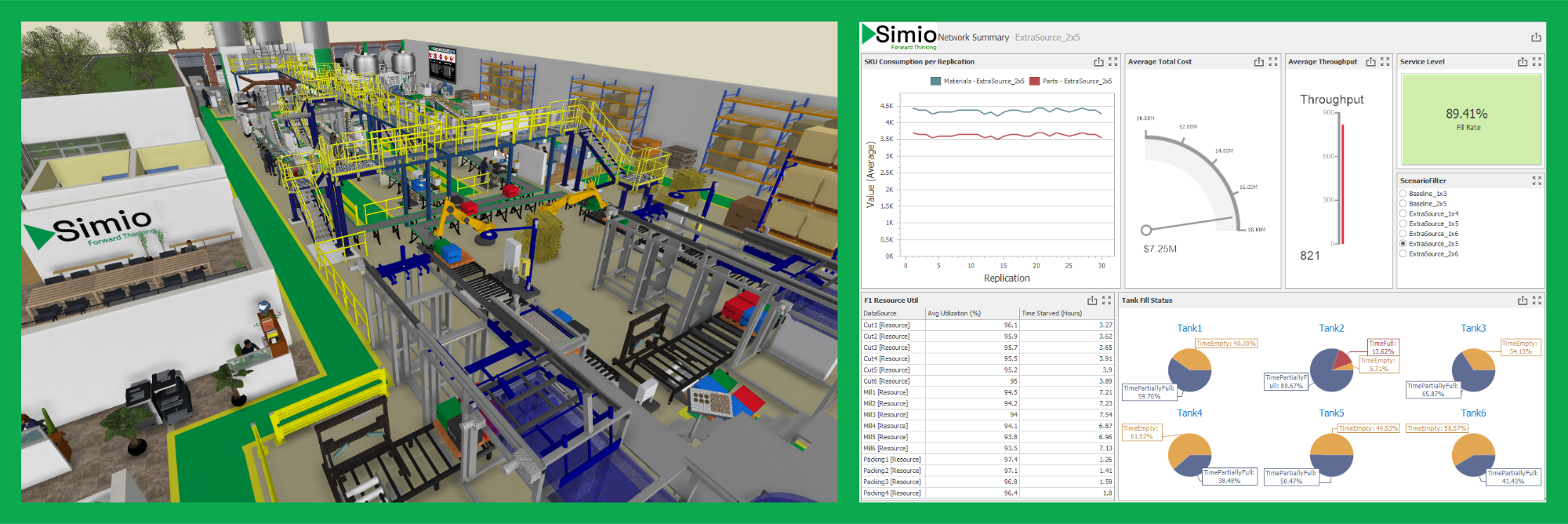
Simio Process Digital Twin models are true digital twins in both operational accuracy and visual detail. With 3D, GIS, and VR capabilities, users have powerful visualization features at their disposal:
- Realistic 3D animation: Displays system behavior with real-time operational status updates
- Multi-format graphic import: Incorporates CAD and 2D & 3D graphics from applications such as SketchUp, AutoCAD, Inventor, and SOLIDWORKS
- NVIDIA Omniverse integration: Enhances collaborative visualization through NVIDIA’s platform
- Dynamic dashboard creation: Updates information during model execution for real-time insights
- Custom viewpoint definition: Highlights specific areas of interest for focused analysis
- Recording and playback: Shares insights with stakeholders through captured simulations
- Extensive 3D symbol library: Accesses over one million free 3D symbols from 3D Warehouse
Real-time simulation with live data feeds creates a dynamic model that evolves as operations change. This visual representation helps stakeholders understand complex systems and builds confidence in the model’s accuracy.
Simulation Experimentation & Analysis
Simio’s integrated model building, simulation, experimentation, and analysis functions empower users to harness the decision-making power of discrete event simulation:
- Automated scenario management: Compares alternatives systematically through organized experimentation
- Ranking and selection procedures: Identifies optimal solutions through structured evaluation methods
- Sensitivity analysis tools: Understands key performance drivers through parameter variation testing
- Risk analysis capabilities: Quantifies uncertainty in outcomes using statistical methods
- Interactive dashboard reporting: Customizes visual displays to match stakeholder expectations
- Gantt chart visualization: Provides exceptional clarity for process visualization and scheduling
- Advanced export functionality: Enables further analysis in Excel or other specialized tools
Simio’s “Glass Box” approach allows users to easily identify constraints or delays related to material or resource availability, ensuring that Process Digital Twin results are both transparent and actionable. The experimentation interface enables quick parameter adjustments across scenarios without coding, comparing configurations against business KPIs to pinpoint the most effective setup.

Fast Runtimes
Simio’s architecture is designed for performance, enabling:
- Rapid model execution: Provides quick feedback regardless of model size or complexity
- Efficient large-model handling: Manages complex models of multi-site facilities and end-to-end supply chains
- Parallel processing utilization: Enables faster experimentation through multi-core computing
- 64-bit architecture support: Accommodates memory-intensive applications and large datasets
- Batch run capabilities: Facilitates extensive analysis through automated scenario execution
- Event-triggered simulation: Automates simulation runs based on system events or schedules
- Optimized data synchronization: Enhances digital twin performance for real-time decision support
Advanced simulation analytics transform raw data into actionable insights for continuous improvement. Simio’s performance optimization ensures that even complex digital twin models run quickly enough to support real-time decision-making.

True Object-Oriented Design
Simio’s patented software architecture enables the creation and modification of intelligent objects without programming:
- Process-based object definition: Defines objects through graphical process flows rather than code
- Logic and animation encapsulation: Creates reusable objects that combine behavior and visualization
- Hierarchical modeling framework: Manages complexity through structured object relationships
- Inheritance-based development: Enables efficient model development and maintenance through object hierarchy
- No-code object extension: Extends existing objects without programming requirements
- Custom library creation: Develops industry- or organization-specific object collections
- Digital twin object framework: Seamlessly integrates with physical systems through standardized interfaces
Objects can be easily shared between projects and users, with intelligent objects interacting as “agents” making autonomous and informed decisions. Simio operates as a “Glass Box” with easily understandable and modifiable objects, stored in a readable XML format that integrates with third-party revision control applications.
Advanced Software Architecture
Simio’s modern architecture supports enterprise-level simulation needs:
- .NET foundation: Enables seamless integration with other systems and technologies
- API access capabilities: Supports custom applications and interfaces through programmable interfaces
- Distributed simulation support: Allows simulation processing across multiple machines for enhanced performance
- In-memory relational database: Provides ultra-fast data access configurable to match any external data source
- Comprehensive data integration: Connects with databases, spreadsheets, and other data sources
- Version control integration: Supports team collaboration through managed development processes
- Digital twin synchronization: Facilitates real-time data exchange between physical and virtual systems
Simio leverages the latest technology and an agile development process to rapidly deliver new features and enhancements, with robust support for scaling computing power and memory to efficiently handle increased scenario replications.
Fully AI/DNN/ML Enabled
Simio embraces artificial intelligence and machine learning to enhance simulation capabilities:
- AI agent embedding: Captures complex decision logic and optimizes operational processes
- Synthetic data generation: Creates clean, labeled data covering the entire solution space for training AI agents
- TensorFlow-powered networks: Trains embedded Neural Networks using industry-standard frameworks
- ONNX model exchange: Exports synthetic training data to external Neural Networks and imports trained models
- Virtual algorithm validation: Tests and validates AI algorithms in a risk-free sandbox environment
- ML configuration optimization: Fine-tunes AI agent performance by evaluating different machine learning approaches
- Python integration: Enables seamless bidirectional workflow integration with data science tools
- NVIDIA AI compatibility: Leverages advanced hardware technologies for enhanced performance
This powerful methodology supports system design, workflow automation, and ongoing optimization. Simio’s architecture empowers model developers and data scientists to leverage Process Digital Twin technology for creating what-if scenarios that support enterprise-wide decision-making.

Flexible Data & Integration Framework
Simio’s open architecture features extensive data integration capabilities:
- Enterprise database connectivity: Connects directly to SQL Server, Oracle, and other enterprise databases
- Excel integration support: Facilitates data import and export with familiar spreadsheet tools
- Multiple format compatibility: Supports CSV, XML, and other common data file formats
- IoT data integration: Incorporates real-time data feeds from IoT devices and other sources
- Web service connectivity: Integrates with cloud-based applications through standard protocols
- Enterprise system synchronization: Maintains digital twin data consistency with operational systems
- MES system integration: Connects with manufacturing execution systems such as AVEVA and Tulip
- IoT gateway compatibility: Supports PTC Kepware IoT Gateway and HighByte Intelligence Hub
- Cloud and ERP connectivity: Provides Web APIs for major platforms (AWS, Azure, Google Cloud) and systems (SAP S/4HANA, OMP, Kinaxis, Oracle, Microsoft Dynamics)
This comprehensive integration framework ensures seamless data flow between physical systems and their virtual counterparts, maintaining synchronization that is essential for effective digital twin implementation.
Scalable Deployments
Simio offers a range of deployment options to meet diverse organizational needs:
- Desktop deployment: Supports individual users with local installation options
- Network license management: Enables team access through centralized license servers
- Enterprise-wide availability: Facilitates organization-wide deployment through scalable architecture
- Cloud-based implementation: Enables large-scale experiments and efficient resource scaling
- Runtime model deployment: Supports operational use of models without development environment
- Multi-scale digital twins: Enables digital twin deployment at any scale, from single processes to entire enterprises
- Collaborative visualization: Provides web-based interactive dashboards for stakeholder engagement
- Role-based access control: Manages enterprise-wide stakeholder engagement through permission systems
Simio’s comprehensive application workstreams span Simulation & Analysis, Process Design & Optimization, Planning & Scheduling, Shop Floor Orchestration, and Design-to-Operate Process Management, ensuring that simulation software can grow with organizational needs.

User Feedback

“Our customers want both choice and speed. By understanding where our customers’ expectations are going, and by leveraging rapid modeling with Simio, we are prepared to tackle this challenge.”
Jarrod Thome
Manager of Process Design & Simulation Modeling
McDonald’s
“The Simio Digital Twin is now used 24/7 to generate plans that are accessible to all. These plans are used in daily management meetings to establish the strategy. The Simio Digital Twin model has now been run over 65,000 times to generate plans. It is equivalent to running the model every hour for over 7 years.”
Jonathan Miller
Industrial Engineer & Simulation Modeler
Alcoa
“Frankly, I’ve been stunned that every time we came up with a new question or level of complexity that we needed to account for in the simulation, the Simio software answered the bell and responded to our needs.”
J. Spencer Williams
Founder, President & CEO
Retirement Clearinghouse
“Across our sites we have multiple Simio users of varying skill level, and we have been able to successfully hand-off models to local teams with guided instructions for how to make conceptual level model changes through data-driven inputs. We view Simio’s data-driven and data-generated model configuration as a key enabler for Digital Twin development.”
Thomas Lewis
Associate Director – Business Insight & Analytics
Bristol Myers Squibb
“We find that the use of objects to quickly build a working model of a plant layout very appropriate. Moreover, the possibility to add additional logic in the case of movement and synchronization of different lines through a set of instructions is easy to implement and expanded our capability to solve more complex problems.”
José Vilar
Project Manager
Nissan Europe
“Simio cannot be replaced or trumped for the power and ability that you gain by using it. The information gleaned from a model like this is truly unmatched. Simio is an incredibly powerful tool that helps make Penske better every day.”
Morgan Mistysyn
Operational Excellence Manager
Penske
“By using the forward-looking benefits that Simio simulation-based performance analytics offer, we saved tens of millions of dollars in unnecessary investments in building expansion projects.”
Mike Lazzaroni
Senior Planning Analyst
Vancouver International Airport
“We modeled the prototype assembly process in Simio and adjusted resources to reduce the lead times from 3 weeks to less than 1 week.”s
Carlos Lares
Senior Business Unit Ops Manager
Skyworks Solutions
“Across all [production] lines and all tested schedules, we were able to demonstrate an 8% throughput lift. This lift was achieved using a black box optimizer developed by McKinsey and a Simio Digital Twin model.”
Wim de Villiers
Senior Data Scientist, QuantumBlack AI by McKinsey
McKinsey & Company
“I like how fast Simio is when I run experiments because it uses all the [processing] cores on my computer. ‘Boom’ and it is done!”
Anna Palmerius
Project Engineer
Vantage Airport Group
“What gives a tool value is flexibility… Simio provides me greater value through flexibility with the addition of 3D animation.”
John T. Carson
Staff Operations Engineer
Lockheed Martin
“The ability to test the planned facilities under various conditions enabled us to understand the different tradeoffs and deliver designs well suited to our customers’ needs, which can be expanded as traffic increases.”
Louis Roy
Senior Airport Planner
AECOM
“The model proved to be very adherent to the real dynamics of the operations of CTC’s cane sugar internal movement in the plant. It also allows you to view points of queuing and resources with high and low occupancy.”
Mara Veronez
Project Engineer
Cosan Combustiveis e Lubrificantes S.A.
“We have built dozens of scalable Digital Twins for our clients with 99% prediction accuracy by leveraging commercial solutions such as Simio as well as building custom solutions in Python.”
Benjamin Braverman
Principle Product Manager, QuantumBlack AI by McKinsey
McKinsey & Company
“The biggest quality of the model was in the realm of visualization. Simio made it easy for those involved to understand the current situation and the projections for future growth. The structure also enabled people to understand how things worked in the background.”
Pascal Poudenx
Airport Process Engineer
Vantage Airport Group
“In my view, Simio allows detailed analysis and individual ‘links’ as well as an aggregated end-to-end analysis and optimization of complex supply chains of the Bundeswehr. Simio adheres particularly well to the supply chain approach.”
Hans-Georg Konert
Managing Director
Konekta Consulting GmbH

Who Uses Simio Simulation Software?
Discrete Event Simulation (DES) creates a low-risk environment for modeling and accurately predicting the behavior and performance of any process or complete system. Through a workstream involving simulation and experimentation, users experience full 3D visualization and deep insight into operational behavior, detailed performance analysis, and powerful process and system performance optimization, leading to informed decision-making and improved system operation. From commercial businesses and government agencies to academic institutions, across every industry and business size, organizations grappling with complex operational challenges can harness the versatile capabilities of Simio’s Discrete Event Simulation software.