

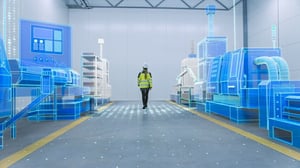
Manufacturing operations have undergone substantial evolution through the adoption of intelligent digital technologies. Digital twin manufacturing represents a critical advancement for over 60% of manufacturing companies that have started smart technology initiatives, according to a 2023 survey from tech advisory firm ISG. Nearly two-thirds of these organizations pursue smart manufacturing primarily to reduce operational costs. Industry leaders like Simio have demonstrated the substantial impact of digital twins, achieving up to 30% savings in operational costs while reducing time-to-market by an impressive 50%.
Digital twins in manufacturing function as dynamic, virtual replicas of physical assets, processes, and systems, enabling continuous monitoring, data analysis, and enhanced decision-making. These sophisticated digital models provide invaluable insights throughout the entire product lifecycle—from design and prototyping to production, operation, maintenance and ongoing continuous improvement. The technology optimizes factory floor configurations, decreases downtime, and delivers deeper understanding of physical assets and manufacturing processes.
Market expansion for this technology continues at an accelerated pace. MarketsandMarkets projects the digital twin market will grow from $10.1 billion in 2023 to $101.1 billion by 2028, representing a compound annual growth rate (CAGR) of 61.3%. Gartner predicts that by 2027, 40% of large industrial companies will use digital twins, resulting in increased revenue. Additional market forecasts suggest digital twin technologies will reach $73.5 billion by 2027, underscoring the substantial economic impact of this technology.
This analysis explores the applications, benefits, and industry insights related to digital twin manufacturing. From understanding the fundamentals of digital twins to examining their implementation and future trends, the following sections illuminate how this technology is reshaping production environments and creating unprecedented opportunities for optimization, efficiency, and innovation.
What is a Digital Twin in Manufacturing? (Simio’s Perspective)
Digital twin in manufacturing represents far more than a virtual replica within Simio’s framework—it constitutes an intelligent, adaptive model that continuously simulates, predicts, and optimizes production systems. Traditional digital models provide static representations, while Simio’s digital twins create dynamic mirrors of physical manufacturing assets that evolve alongside real-world conditions.
Definition and scope of Simio’s digital twin framework
Simio defines a manufacturing digital twin as a near real-time digital representation of a physical manufacturing process or system used to optimize business performance. This definition emphasizes the critical link between virtual models and physical reality. Digital twins essentially function as virtual testbeds where manufacturers can explore “what-if” scenarios without disrupting actual operations.
The scope of Simio’s framework extends beyond mere visualization, encompassing:
- Predictive analytics for production outcomes
- Risk assessment across multiple scenarios
- Real-time decision support for manufacturing operations
- Continuous learning, process improvement and adaptation capabilities
Simio’s approach treats digital twins as evolving entities that grow smarter and more accurate over time rather than static models with predetermined behaviors.
Distinction between near real-time and traditional simulation methods
Traditional simulation methods typically operate on static sets of historical or planned future data and often require significant time to analyze and generate insights. Simio’s near real-time digital twins fundamentally differ through several key characteristics:
- Responsiveness: Traditional simulations run as and when required to perform specific analysis, whereas near real-time digital twins respond to ongoing changes in production environments almost immediately to provide ongoing insights for decision support.
- Adaptation: Conventional models maintain fixed parameters and require manual changes, while Simio’s digital twins automatically adjust to changing conditions on the factory floor to remain in sync with current conditions and configurations.
- Learning capability: Traditional simulations require manual updates, but near real-time twins continuously adjust based on the latest operational data.
- Decision automation: Standard simulations generally provide analysis for human decision-makers, while Simio’s approach enables autonomous decision-making within defined parameters and trigger events such as equipment failure.
This shift from periodic (as required) to continuous simulation for near-real time decision support, represents a fundamental advancement in manufacturing intelligence, enabling proactive rather than reactive management strategies.
Types of digital twins in Simio’s ecosystem (Resource, process, system and supply chain)
Simio’s ecosystem recognizes four primary types of digital twins, each serving distinct yet complementary manufacturing purposes:
Resource Digital Twins focus on individual resources or equipment, modeling their physical characteristics, performance parameters, and lifecycle behavior. These twins optimize resource configuration and anticipate maintenance and operator support needs.
Process Digital Twins represent specific manufacturing processes, capturing task sequences, resource requirements, tooling, labor, maintenance and quality parameters. These models enable process optimization and variance reduction for each specific process.
System Digital Twins integrate multiple processes and products into comprehensive models of entire manufacturing systems or factories including warehousing and logistics. These high-level twins coordinate complex operations and optimize system-wide performance.
Supply Chain Twins integrate multiple factories, warehouses and logistics operations into a single network model to optimize overall business performance and risk management across the entire supply chain or supply network.
These four types often work together within integrated hierarchical manufacturing environments or networks, creating a multi-layered digital representation of the entire end-to-end operations.
The “glass box” approach to transparent decision-making
Simio’s “glass box” approach transforms traditionally opaque process optimization tools into transparent near-real time decision-making tools. Unlike “black box” systems that obscure underlying logic, Simio’s glass box methodology:
- Makes simulation logic fully visible and understandable
- Enables stakeholders to trace how specific inputs lead to particular outputs
- Builds trust in simulation results through 3D visualization
- Facilitate collaborative problem-solving across different departments and business units
This transparency proves especially valuable when implementing digital twins to fully understand the impact of specific business rules and management policies are on the overall performance of the business. The glass box approach helps manufacturing teams understand not just what changes to make and specific actions to take but specifically why those changes and actions will lead to improved outcomes.
The combination of near real-time capabilities with transparent decision logic enables manufacturers to transform operations from reactive to predictive systems, continuously optimizing performance based on both current conditions and anticipated future states.
Evolution of Digital Twin Technology in Manufacturing
Digital twin technology emerged from aerospace applications decades before the term gained widespread recognition. NASA’s Apollo missions in the 1960s featured engineers creating physical duplicates of spacecraft systems to troubleshoot problems remotely. These early models, though physical replicas and rudimentary by contemporary standards, established the foundational principles for what would eventually become digital twin technology.
Historical development from static to dynamic models
Dr. Michael Grieves introduced the formal concept of digital twins at the University of Michigan in 2002. Early digital models functioned primarily as static representations—simple digital copies with limited functionality that couldn’t update in real-time or interact with physical objects. The 2010s witnessed evolution into what industry experts termed “digital shadows”—models that displayed the state of physical objects with one-way data flow from the physical asset to its digital counterpart.
A critical distinction emerged between these initial approaches and true digital twins. Deloitte noted, “until recently, the digital twin—and the massive amounts of data it processes—often remained elusive to enterprises due to limitations in digital technology capabilities as well as prohibitive computing, storage, and bandwidth costs.” These obstacles diminished dramatically as computing power advanced, enabling the integration of information technology (IT) and operations technology (OT).
Transition to near real-time capabilities
Fully interactive digital twins established bidirectional communication between the physical processes and their digital replicas. This two-way data exchange created powerful feedback loops that enhanced optimization, labor utilization, predictive maintenance, and decision-making processes.
Prior to recent advancements, digital twins primarily served as simulation tools rather than interactive systems. According to thatdot, “until recently, digital twins were used to simulate real-world processes rather than interact with the world in real time. Either synthetically generated or previously captured data was run (and rerun) in controlled scenarios.”
Three converging technologies powered the transition toward real-time capabilities:
- Internet of Things (IoT) – Providing the sensor infrastructure and data collection capabilities
- Cloud Computing – Offering the necessary storage and computational power
- Artificial Intelligence – Enabling pattern recognition and predictive analytics
This technological convergence has fueled remarkable market growth.
Simio’s role in advancing intelligent adaptive simulation
Simio has pioneered advancements in digital twin technology through its intelligent adaptive process digital twins. Unlike traditional simulation tools, Simio’s platform creates models that automatically adapt to changing environments as data shifts, providing forward visibility into planned operations.
Simio became the first Discrete-Event-Based Digital Twin Simulation software company to offer native, embedded support for Neural Networks. This innovation eliminates the need for external third-party applications, streamlining the implementation process and enhancing functionality.
Integration with Industry 4.0 principles and smart factories
The integration of digital twins with Industry 4.0 represents the “physical-digital-physical journey.” This loop forms the cornerstone of the fourth industrial revolution, where digital manufacturing environments combine advanced techniques with IoT to create interconnected enterprises.
Digital twins now serve as the critical missing component in enabling smart factories. They provide the detailed factory model that delivers forward visibility into planned operations, supporting ongoing continuous improvement initiatives.
Through this evolution from static models to dynamic, real-time systems, digital twin technology has progressed from a specialized aerospace tool into an essential component of modern manufacturing strategy.
Core Components of Simio’s Manufacturing Digital Twin
Effective digital twin manufacturing depends on integrated technological components that convert raw data into a digital replica of the process that provides actionable insights based on the current status of the process. Simio’s approach combines several critical elements to create a comprehensive platform to develop digital twin that reflects physical manufacturing environments with exceptional accuracy.
Intelligent modeling framework with 3D visualization
Simio’s digital twin architecture begins with its intelligent modeling framework. This system enables the creation of detailed digital replicas of manufacturing operations with accurate spatial relationships and functional behaviors. Unlike basic CAD models, these visualizations incorporate dynamic behaviors that simulate how physical assets interact under various conditions.
The 3D visualization capabilities provide multiple operational advantages:
- Observation of manufacturing processes from multiple perspectives
- Identification of spatial constraints and bottlenecks
- Communication of complex operational concepts to stakeholders
- Validation of proposed changes before physical implementation
This visual element serves as the interface between complex data processing and human decision-makers, making abstract manufacturing concepts immediately understandable.
Event-driven processing architecture for state changes
Beneath the visual layer, Simio’s digital twins employ a discrete event-driven processing architecture that responds to state changes in the manufacturing environment. Rather than relying on fixed-interval updates, the system processes information when specific trigger events or meaningful state changes occur.
This approach delivers several operational benefits. The system reacts only when required based on trigger events or specific changes in expected behavior. Critical events receive immediate attention regardless of when they occur. The architecture creates a more accurate reaction to events in the operations, where changes can happen asynchronously rather than on predetermined schedules.
Near real-time data synchronization methodology
Connecting physical resources to their digital counterparts requires sophisticated data synchronization methods. Simio’s platform maintains continuous alignment between real-world manufacturing operations and their digital representations through bidirectional data flows.
The system captures data from multiple sources simultaneously, including sensors, controllers, MES and ERP systems. This information undergoes processing to update the digital twin’s state, ensuring decisions are based on current conditions rather than historical snapshots.
AI integration for near-real time optimization
Beyond merely reflecting current states, Simio’s digital twins are developed to include all the process constraints, business rules and detail decision logic on the shop floor allowing it to accurately replicate the real-world behavior of the process or factory
This allows the Simio Digital Twin to run 1000’s of scenarios, creating synthetic labeled training data to train Neural Networks, when imbedded in the Digital Twin, can make optimized decisions, given any situation that may occur, during model runtime, when creating a new schedule for shop floor execution.
This capability is unique to Simio and provides unprecedented power allowing for the training, testing and embedding of neural networks into the Simio Digital Twin models.
Enterprise system integration (ERP, MES, IoT)
Simio’s digital twins connect seamlessly with existing enterprise systems. This integration ensures data flows freely between planning systems like ERP (Enterprise Resource Planning), execution systems like MES (Manufacturing Execution Systems), and operational technologies including IoT devices.
The platform serves as a central hub where information from disparate sources converges to create a complete view of manufacturing operations. The Simio Process Digital Twin becomes a magnifying glass for the enterprise data where it all comes together in a single enterprise Digital Twin. This approach enables truly holistic decision-making that considers all relevant factors simultaneously.
These five core components create a digital twin framework that bridges the gap between physical manufacturing resources and processes and their virtual representations, enabling exceptional visibility, analysis and control over production operations.
How Simio’s Digital Twins Function in Manufacturing Environments
Implementing digital twins in manufacturing environments follows a structured approach that eventually enables the connection of physical systems with virtual models. This process creates a dynamic and continuous feedback loop that enhances decision-making and optimizes production workflows.
Step 1: Data acquisition from physical manufacturing assets
Effective digital twin manufacturing begins with comprehensive data collection from physical production environments. This process involves deploying sensors throughout manufacturing facilities to capture real-time information about equipment performance, production rates, and environmental conditions. The data acquisition layer includes programmable logic controllers (PLCs), supervisory control and data acquisition (SCADA) systems, and IoT devices that continuously monitor operational parameters. These connected devices transmit information through secure industrial networks, ensuring digital twins receive accurate and timely data streams.
Step 2: Digital model creation with Simio’s platform
Once data connections are established, Simio’s platform enables the creation of comprehensive digital twin models that mirror physical manufacturing systems. This stage involves mapping physical resources and their relationships, defining process workflows, and establishing logical connections between components. The platform supports both detailed component-level modeling and broader system-wide representations, allowing organizations to scale their digital twin implementation based on specific operational needs. These models incorporate both geometric information and behavioral logic that governs component interactions.
Step 3: Simulation and unlimited scenario testing
Digital model establishment enables unlimited scenario testing without disrupting physical operations. Organizations can explore various production scenarios, test different scheduling strategies, and evaluate potential process improvements within a risk-free virtual environment. This capability allows for rapid iteration and experimentation that would prove impractical or impossible in physical manufacturing settings. The simulation environment serves as a sandbox where innovative approaches undergo testing before implementation.
Step 4: Predictive analytics and optimization
Digital twins apply advanced experimentation and analytics to predict future states and identify optimal operating parameters. This step involves processing of historical, current or future forecasted data to predict production outcomes, identify potential bottlenecks, and recommend process improvements. These predictive capabilities enable organizations to transition from reactive to proactive management, addressing potential issues before they impact actual production efficiency.
Step 5: Continuous adaptation through rolling planning
The final step implements a rolling planning process where digital twins continuously update based on new data and changing conditions. This adaptive approach ensures digital models remain aligned with physical reality even as manufacturing conditions evolve. Rolling planning enables ongoing optimization as digital twins learn from operational outcomes and refine their predictions and recommendations accordingly. This creates a continuous improvement cycle where each production cycle informs and enhances future operations.
How to Implement Simio’s Digital Twin in Your Facility
Successful implementation of digital twin technology requires a structured approach that ensures maximum return on investment. Based on industry best practices, the following five-step roadmap introduces digital twin capabilities into manufacturing facilities.
Step 1: Identify high-value resources and processes
Manufacturing organizations should begin by assessing which resources and processes would benefit most from digital twin implementation. Focus areas include:
- Frequent bottlenecks or quality issues
- High-value equipment where downtime creates significant costs
- Complex processes requiring frequent adjustments
- Critical production lines affecting overall throughput
This targeted approach ensures resources are directed toward applications with the greatest potential impact on operational efficiency and profitability.
Step 2: Develop data collection strategy
Establishing the data foundation requires determining what information the digital twin requires for accurate modeling. This process involves:
- Identifying required data points for accurate modeling
- Selecting appropriate sensor technologies and IoT devices
- Establishing data quality standards and validation protocols
- Determining optimal data sampling and upload frequencies
The digital twin’s accuracy depends entirely on the quality and completeness of the data collection process and pipeline.
Step 3: Create the digital model using Simio’s platform
After establishing the data infrastructure, organizations construct their digital model through:
- Importing existing CAD files and facility layouts
- Defining logical relationships between system components
- Establishing operating parameters and business rules
- Validating the model against known historical data
This step transforms raw data into an interactive virtual environment that accurately represents physical assets.
Step 4: Connect to near real-time data streams
Once the model is built, integration with live data streams creates a truly dynamic digital twin. This requires:
- Establishing secure connections between physical data and the digital model
- Implementing data processing pipelines that handle incoming information
- Setting up monitoring dashboards for operational visibility
- Defining alert thresholds for critical parameters
This connection creates the continuous feedback loop essential for effective digital twin operation.
Step 5: Apply AI for decision support and optimization
The final step incorporates the use of neural networks to unlock the digital twin’s full potential. This enables:
- Creation of synthetic label training data to train any neural network (internal) or AI agent (external)
- Testing of trained neural network for confirm and validate the expected behavior
- Embedding neural networks or trained AI agents into the digital model for instant optimization decisions
- Enables closed-loop optimization with external AI/ML agents for total business optimization, driving incremental improvement through additional learning and observations of system behavior and responses
Through these capabilities, the digital twin evolves from a monitoring tool to a strategic asset that actively drives manufacturing excellence.
Simio’s Technical Architecture for Digital Twin Implementation
Effective digital twin implementation requires a sophisticated technical architecture that integrates multiple advanced technologies. Simio’s platform combines these components to create robust digital representations of manufacturing environments.
Stochastic modeling for realistic simulations
Simio’s architecture employs stochastic modeling techniques that incorporate randomness and variability to create realistic manufacturing simulations. This approach recognizes that real-world production environments rarely operate with perfect predictability. The platform embeds probability distributions within simulation models, enabling the digital twin to accurately reflect uncertainties in processing times, equipment failures, and material flows. This probabilistic foundation allows organizations to assess risks and explore multiple potential outcomes rather than relying on single-point predictions.
Event-driven processing capabilities
The technical core of Simio’s platform features event-driven processing that responds to state changes and events as they occur. This approach differs from time-step methods by processing events in chronological sequence regardless of timing. The digital twin maintains perfect synchronization with physical resources, capturing critical state changes without arbitrary sampling intervals. This methodology ensures all events are executed as and when they occur to synchronize all task to the actual execution timeline.
AI integration framework
Simio’s architecture incorporates a sophisticated AI integration framework that enhances decision support and optimization capabilities. This framework connects machine learning algorithms directly with simulation models, creating systems that continuously improve through operational experience. The platform supports both built-in AI capabilities and connections to external machine learning services using the industry standard ONNX framework, providing flexibility based on specific organizational requirements.
Enterprise system connectivity
The platform features comprehensive connectivity options for integration with existing enterprise systems. These connections extend beyond simple data transfer, establishing bidirectional communication channels with ERP, MES, and IoT systems. The digital twin becomes fully embedded within operational technology ecosystems rather than functioning as an isolated tool.
Future of Digital Twin Technology in Manufacturing
Digital twin technology continues to advance through technological innovations that extend capabilities beyond current implementations. Manufacturing digitization accelerates toward unprecedented levels of automation, efficiency, and intelligence through emerging technological convergence.
Emerging trends in Simio’s technology roadmap
Simio’s technology roadmap emphasizes the convergence of cloud computing with digital twin platforms. This cloud-based approach provides the scalability necessary for processing massive datasets efficiently, expanding capacity for real-time analysis on a large scale. Improvements in IoT and sensor technologies will enrich data supplied to digital twins, enhancing both their predictive power and ability to model complex scenarios.
Enhanced AI integration for improved predictive accuracy
AI integration within digital twins represents a significant advancement in predictive analytics and simulation. These developments include:
- Machine learning algorithms that identify patterns from historical data
- Deep reinforcement learning creating new ways to optimize factory operations
- Embedded Python scripting to enhance complex decision logic
According to McKinsey, these combined ML and optimization approaches with simulated replicas are allowing companies to drive new performance levels in real time.
Expanded automation capabilities
Digital twins will significantly advance manufacturing automation. AI-powered digital twins are paving the way for autonomous factories where machines self-optimize, self-repair, and collaborate seamlessly. Gartner notes that 20% of discrete manufacturing processes are expected to be fully autonomous by 2027.
Integration with broader Industry 4.0 technologies
Integration with 5G and 6G networks and edge computing will enable faster data processing and low-latency connectivity. Augmented reality and virtual reality integration will create immersive interfaces where workers interact with digital models overlaid on physical assets. Blockchain technology may ensure secure, transparent data sharing across manufacturing supply chains.
Conclusion
Digital twin technology has established itself as a fundamental component of modern manufacturing strategy through virtual replicas that mirror physical assets with remarkable precision. This analysis has examined how Simio’s approach creates intelligent, adaptive models that deliver up to 30% savings in operational costs while reducing time-to-market by approximately 50% for industry leaders.
The progression from static models to dynamic, near real-time systems represents a significant advancement in manufacturing intelligence. Manufacturing facilities can now benefit from continuous monitoring, predictive analytics, and unlimited scenario testing without disrupting actual operations. The glass box approach ensures complete transparency in decision-making processes, building trust across organizations.
Effective implementation follows a structured methodology—identifying high-value assets, developing sensor networks, creating accurate models, connecting real-time data streams, and applying AI for optimization. This systematic approach ensures maximum return on technology investment.
Simio’s technical architecture combines stochastic modeling, event-driven processing, AI integration, and enterprise connectivity to create a comprehensive manufacturing intelligence system. Production environments gain the ability to anticipate issues before they occur, optimize scheduling dynamically, and continuously improve operations through data-driven insights.
The technology’s expansion continues through enhanced AI integration, improved predictive accuracy, and broader automation capabilities. Market projections indicate extraordinary growth, and this trajectory reflects the technology’s proven value across diverse manufacturing sectors.
Digital twins have evolved from specialized tools to essential components of modern manufacturing operations. The convergence of physical and digital manufacturing environments offers unprecedented visibility, control, and optimization capabilities that will continue to redefine production excellence.
Simio stands at the forefront of this digital manufacturing evolution. Through cutting-edge digital twin software that combines discrete event simulation with robust real-time analytics, Simio empowers organizations to manage their operations dynamically. The platform adapts to evolving technological needs, offering solutions for everything from predictive scheduling to risk-based analysis. Organizations can harness the full potential of digital twin technology, mitigate risks, and stay ahead of market demands—all while fostering operational resilience and continuous improvement.