

Static constraints
Simio Advanced Planning and Scheduling (APS Software)
Simio Discrete Event Simulation Powered Advanced Planning and Scheduling (APS) leverages Intelligent Adaptive Process Digital Twin technology to perform real-time, synchronized, risk-based dynamic scheduling. This state-of-the-art approach transforms traditional planning challenges into strategic advantages by creating virtual replicas of your entire production environment. Digital twin planning and scheduling enables feasible plans and schedules for manufacturing, warehouse, and supply chain execution across all relevant time ranges, ensuring that all operations are resource-capacity, material, and timeline feasible.
.svg)
Why Simio for APS?
Using Simio Intelligent Adaptive Process Digital Twins to perform Advanced Planning and Scheduling (APS) enables real-time analysis through sophisticated what-if simulations. This powerful digital twin planning capability helps you make decisions that ensure your business meets its commitments by effectively managing unexpected disruptive events such as machinery breakdowns, material shortages, and unplanned orders. Simio’s agile platform for developing Intelligent Adaptive Process Digital Twins allows you to easily build data-generated simulation models without coding, fully capturing detailed constraints, business rules, and decision logic within your system.
Digital twin scheduling represents both discrete events and flow processes within the same model, while realistic 3D animation provides an engaging visual representation of your entire operation. With powerful AI-enabled optimization at your fingertips, you can freely experiment with operational scenarios, facilitating detailed what-if analyses that result in comprehensive insights into system performance. This robust digital twin approach empowers your teams to make informed decisions and maximize business KPIs through accurate simulations of future operational states.

Absolute Feasibility
- Simulation-based architecture: Simio Advanced Planning and Scheduling operates with a Discrete Event Simulation-based, object-oriented, 3D architecture that ensures planning/scheduling that are material, capacity, demand and timeline feasible through the use of its intelligent digital twin technology.
- Dynamic virtual replicas: Process Digital Twins incorporate dynamic digital replicas of the processes, equipment, people, and devices that make up factories, warehouses, and supply chains—creating a comprehensive virtual testing ground for what-if scenarios.
- Intelligent resource modeling: System resources in Process Digital Twins not only have busy, idle, and off-shift states, but they are also modeled as objects that exhibit behavior and move around the system. These resources interact with other objects to fully replicate the behavior and detailed constraints of real-world operating environments.
- Real-time decision making: Production scheduling decisions are made at the exact event time when resources and materials are required. Dynamic dispatching rules and detailed process logic are then applied to decide the next order to process and which resources to use.
- Synchronized operations: Absolute operational feasibility is ensured by fully synchronizing all material and resource requirements with the actual event timeline for each operation through accurate digital twin simulation.
Accurate & Verifiable Results
- Comprehensive solution: Simio Advanced Planning and Scheduling ensures predicted performance results are accurate and verifiable through the application of Process Digital Twins. These intelligent digital twins incorporate all physical constraints, business rules, operating procedures, safety protocols, and operational decision logic required to effectively operate factories, warehouses, and supply chains.
- Preventive maintenance planning: Minimize the impact on performance due to preventive maintenance and specific operational requirements by intelligently planning for it through what-if scenario simulation and digital twin planning/scheduling.
- Throughput optimization: Improve throughput while maintaining schedule feasibility by making operational decisions based on expert insights generated from digital twin simulations focused on mission-critical factors such as resource utilization and material availability.
- Future state visibility: Digital twin scheduling provides unprecedented visibility into future operational states, allowing managers to validate plans before implementation to reduce the overall risk of meeting the business KPIs.

Fast Runtimes
- Efficient simulation engine: Simio Advanced Planning and Scheduling operates with Process Digital Twins, powered by fast and efficient Discrete Event Simulation—essential for rapid what-if scenario testing.
- Comprehensive solution: Simio Advanced Planning and Scheduling ensures predicted performance results are accurate and verifiable through the application of Process Digital Twins. These intelligent digital twins incorporate all physical constraints, business rules, operating procedures, safety protocols, and operational decision logic required to effectively operate factories, warehouses, and supply chains.
- Preventive maintenance planning: Eliminate unplanned downtime due to preventive maintenance and operational requirements by planning for and expecting everything through what-if scenario simulation and digital twin planning.
- Throughput optimization: Improve throughput while maintaining schedule feasibility by making decisions based on expert insights generated from digital twin simulations focused on mission-critical factors such as resource utilization and material availability.
- Future state visibility: Digital twin scheduling provides unprecedented visibility into future operational states, allowing managers to validate plans before implementation.

Rapid Model Creation & Automatic Updates
- Templatized model objects: All Process Digital Twin model objects and properties are templatized to be data-generated and data-driven, enabling rapid model creation and minimizing long-term support requirements.
- Adaptive digital twins: Process Digital Twins automatically adapt to changes in enterprise data, ensuring current state and minimizing long-term maintenance of your digital twin planning system.
- No-code development: No coding is required to build Simio Process Digital Twins, dramatically reducing implementation time and technical barriers.
- Customizable libraries: Industry and company specific templates and libraries can easily be created, allowing digital twin technology to be tailored to your specific operational requirements.

Bucketless Planning
- Continuous planning horizon: Simio Advanced Planning and Scheduling supports bucketless planning, enabling the generation of rolling plans/schedules over any selected time horizon through continuous digital twin simulation.
- WIP-initialized simulations: Simulations of operating environments are always initialized with current work-in-progress and optimized related to tasks and materials on a continuous timeline to ensure continuity across current operations between planning periods.
- True production representation: Digital twin scheduling eliminates arbitrary time buckets, providing a more accurate representation of your actual production environment and enabling true what-if scenario testing.
Fully Transparent “Glass Box” Approach
- Transparent planning process: Simio Advanced Planning and Scheduling employs a “Glass Box” approach to the process of generating plans/schedules — rather than a “Black Box” approach. This ensures that operational parameters and resource settings are clear to the business and can be tested, validated, and supported by operations.
- Actual resource loading: Plans/schedules are based on the actual current resource loading across the system at all times, with digital twin technology providing complete visibility into the decision-making process.
- Understandable business rules: A “Glass Box” approach means that business rules and operational decision logic can be easily understood within the digital twin, and therefore can be challenged and evaluated for their impact and value.
- Transparent decision making: Digital twin planning provides stakeholders with clear visibility into how decisions are made as well as the impact based on clear KPIs, building trust in the system to facilitate ongoing continuous improvement.
The Power of What-If Simulation in Digital Twin Planning
Digital twin technology transforms production planning and scheduling by creating a virtual replica of your entire operation—from equipment and processes to workers and materials. This revolutionary approach enables true what-if scenario testing before implementation. By leveraging an intelligent digital twin, organizations can:
Test production strategies
Simulate the impact of different production strategies before committing resources to implementation.
Evaluate equipment changes
Test the effects of adding or reallocating equipment in a risk-free virtual environment without disrupting actual operations.
Optimize workforce allocation
Predict how changes in staffing, shifts, or skill distributions will affect throughput and production efficiency.

Plan for disruptions
Analyze the ripple effects of unexpected disruptions and develop robust contingency plans before problems occur.

Refine production sequences
Optimize production sequences to minimize changeover times and maximize efficiency across your entire operation.

Balance competing priorities
Balance competing priorities and constraints to achieve optimal business outcomes aligned with strategic objectives.
The digital twin approach to planning and scheduling represents a paradigm shift from traditional methods. Instead of relying on static calculations or simplified models, Simio’s digital twin technology captures the complex, dynamic nature of real-world production environments. This comprehensive simulation capability ensures that plans are not only feasible but optimal across all relevant dimensions of your operation.
Core Digital Twin APS Capabilities

Risk-Based
- Stochastic simulation: Simio’s APS engine uses stochastic Discrete Event Simulation technology for comprehensive forward-looking assessment of expected production performance.
- Variability modeling: The intelligent digital twin accounts for risk associated with variability and random events to ensure generated schedules will meet performance expectations.
- Risk quantification: What-if simulation capabilities provide realistic assessment of potential operational risks before they impact actual production.

Data-Generated
- Intuitive interfaces: Simio provides both a traditional point-and-click user interface and a data-generated, data-driven approach for building digital twins.
- Accelerated development: The data-driven approach speeds model creation for complex scenarios and facilitates model reuse across the organization.
- Scalable architecture: Data-generated models support scaling to new sites, multi-site applications, and end-to-end supply chains with minimal additional effort.

Scalable Deployments
- Flexible deployment options: Simio offers multiple deployment approaches, including cloud-based solutions, to maximize access for all stakeholders.
- Enterprise accessibility: Both internal and external stakeholders can leverage digital twin technology for Simulation, Planning & Scheduling, and Shop Floor Orchestration.
- Broad organizational reach: Deployment flexibility ensures digital twin planning and analysis benefits can be realized throughout your entire organization via any web-enabled device.
AI-Enabled
- Neural network integration: Simio supports training, testing, and embedding Deep Neural Network agents into Process Digital Twin models.
- Machine learning compatibility: Bidirectional interaction with Machine Learning algorithms enhances model intelligence and optimizes simulation results.
- ONNX format support: Direct import and use of AI Agents through the widely supported ONNX format supports the creation of truly intelligent digital twins.

Integrations
- Comprehensive connectors: Simio’s architecture includes bidirectional database connectors, support for Excel and CSV files for seamless data exchange.
- API connectivity: Web APIs enable cloud, enterprise system (ERP/MES), and IoT device integrations to create a connected digital ecosystem.
- Programming interfaces: Support for C#, Python, and SQL provides complete flexibility for custom integration development.

Object-Oriented
- No-code development: Build comprehensive digital twin models using intelligent out-of-the-box object libraries without writing code.
- Library extensibility: Easily expand object libraries through subclassing and creating custom user- and industry-specific objects.
- Hierarchical modeling: Any Simio model can be used as an object in another Simio model, facilitating reuse and multi-level system representation.

Templates
- Application-specific libraries: Simio provides pre-built templates containing predefined objects, process logic, and data schemas for common scenarios.
- Rapid implementation: Templates jump-start digital twin model development for complex operational processes, reducing time-to-value.
- Customization options: Each template is fully customizable to fit specific user requirements while maintaining the underlying simulation logic.

3D Visualization
- Multi-dimensional visualization: Process Digital Twin models are true digital twins in both operational accuracy and visual detail.
- Advanced visual capabilities: 3D, GIS, and VR capabilities provide powerful visualization options to enhance understanding of complex systems.
- Comprehensive reporting: Extensive data reporting, Gantt charts, and dashboards validate model behavior and showcase operational performance.
Seamless Integration
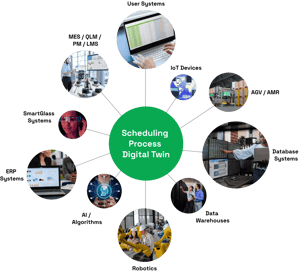
Simio Advanced Planning and Scheduling features a robust toolkit of integration technologies that can seamlessly integrate a Process Digital Twin into the information systems managing your organization’s day-to-day operations. During the implementation phase, the Process Digital Twin is configured to interface with both transactional information systems, which provide inputs on work orders, job routings, and staffing levels, and operational information systems, which track the status of resources and the transformation of raw materials into finished products.
Interconnectivity between enterprise systems and the Process Digital Twin is a crucial step towards realizing the Smart Factory and enabling true what-if scenario testing. The intelligent digital twin continuously updates based on real-time data, ensuring that simulations accurately reflect current operational realities and enable proactive decision-making.
The Process Digital Twin model of a factory provides three key levels of decision support to ensure schedule feasibility while adhering to all system constraints:
- Physical constraint modeling: All physical constraints, including resources, material, and labor capacity limitations are accurately represented in the digital twin.
- Business rule implementation: All pertinent business rules, such as MOQs, inventory policies, and labor policies are encoded within the simulation model.
- Tribal knowledge capture: The detailed decision logic on the shop floor, including equipment preferences and operator skills, often undocumented and considered part of the “tribal knowledge” of the operators.
This comprehensive approach to digital twin planning and scheduling ensures that all aspects of your operation are accurately represented in the simulation model, leading to truly feasible and optimized production plans.
Cloud Deployment for Operational Use
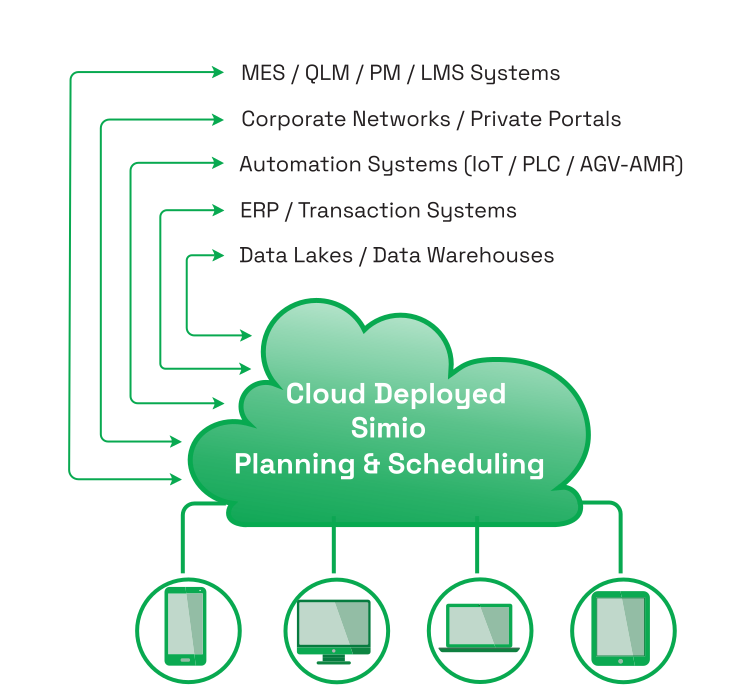
Simio Advanced Planning and Scheduling can be operated on the desktop or deployed in the cloud for manufacturing, warehousing, and supply chain applications. A Simio cloud deployment offers significant flexibility and a broad range of features, enabling stakeholders across the enterprise to engage in digital twin planning and scheduling processes. Stakeholders can perform various activities, including:
- KPI optimization: Experimenting with what-if scenarios through the digital twin to improve key performance indicators across the operation.
- Performance visualization: Analyzing predicted performance using detailed Gantt charts and dashboards generated from digital twin simulations.
- Shift planning: Reviewing detailed schedules for upcoming shifts based on intelligent digital twin recommendations for optimal resource utilization.
- Priority order assessment: Gaining insights into how priority orders affect overall process efficiency and throughput through comprehensive scenario testing.
- Forecast impact analysis: Using long-term planning simulation results to assess the impact of sales forecasts on resources, inventory and the overall supply chain.
- Automation integration: Evaluate the impact of integrating automation, such as AGVs/AMRs and robotics, to improve efficiency and throughput in the warehouse through risk-free digital twin simulation.
Simio’s cloud deployment includes a versatile Web API that enables seamless integration with operational environments, enterprise applications, and data sources. Simio Advanced Planning and Scheduling supports automated schedule generation that includes the triggering of re-planning/scheduling based on real-time events happening anywhere across the system.
Future-Proof Your Operations: Digital Twin Answers to Modern Challenges
Today’s manufacturing and supply chain operations face unprecedented complexity, volatility, and competitive pressures. Digital twin technology offers powerful solutions to these challenges by providing virtual proving grounds for testing strategies before implementation. The following critical challenges are driving organizations to adopt intelligent digital twin planning and scheduling:

Market Volatility
Challenge: Manufacturing and warehousing operations must now serve as response buffers for supply chains, adapting to increasingly unpredictable demand patterns and market disruptions.
Digital Twin Solution: Advanced simulation provides the agility needed to navigate dynamic market conditions through robust what-if scenario testing, enabling proactive rather than reactive responses to market shifts.
Expanding Product Complexity
Challenge: Customers demand increased product variety and configurability with smaller minimum order quantities and shorter product life cycles, straining traditional production planning approaches.
Digital Twin Solution: Intelligent digital twins enable rapid adaptation to evolving product requirements through dynamic production scheduling that efficiently manages increasingly complex product mixes.

Supply Chain Fragility
Challenge: Manufacturing facilities must navigate increasingly complex global supply networks while maintaining resilience against disruptions that can cascade throughout the system.
Digital Twin Solution: Comprehensive visibility into supply chain dynamics enables optimized planning across the entire network, identifying potential failure points before they impact operations.

Compressed Time Horizons
Challenge: End customers expect shorter lead times, precise delivery windows, and complete transparency into order status and supply chain performance.
Digital Twin Solution: Simulation-based scheduling enables more accurate delivery predictions and identifies opportunities to reduce lead times while maintaining feasibility across all constraints.

Institutional Knowledge Loss
Challenge: Manufacturing companies face critical knowledge drain with approximately 25% of their employees aged 55 and over retiring at a rate of 10,000 per day.
Digital Twin Solution: Digital twins capture and preserve institutional knowledge within simulation models, ensuring continuity of operations by encoding expert knowledge into reusable digital assets.

Material Supply Volatility
Challenge: Organizations face unpredictable material availability, extended lead times, and price fluctuations that disrupt production planning and impact profitability.
Digital Twin Solution: What-if simulations allow planners to test alternative sourcing strategies and buffer levels, optimizing inventory while maintaining production continuity through supply disruptions.

Sustainability Imperatives
Challenge: Manufacturing operations must meet increasingly stringent environmental regulations while reducing carbon footprints and resource consumption to achieve sustainability goals.
Digital Twin Solution: Virtual experimentation enables evaluation of energy-efficient processes and resource optimization strategies before implementation, supporting sustainable operations without compromising productivity.

Automation Integration Complexity
Challenge: Implementing automated systems alongside human workers creates complex orchestration challenges that can undermine productivity if not properly synchronized.
Digital Twin Solution: Digital twin simulations model the interaction between automated systems and human workers, optimizing collaboration patterns and ensuring smooth integration of new technologies.

Rising Labor Costs
Challenge: Increasing labor costs and skilled worker shortages force manufacturers to maximize workforce productivity while maintaining quality and operational continuity.
Digital Twin Solution: Workforce optimization through digital twin modeling identifies ideal staffing levels, skill distributions, and shift patterns that maximize productivity while controlling labor costs.
The Simio Digital Twin Advantage for APS
When implementing Advanced Planning and Scheduling, the ability to simulate and optimize before actual operation delivers transformative benefits. Digital twin simulation prevents costly implementation mistakes and eliminates risky experimentation on your actual production floor. This approach ensures APS success from day one through evidence-based configuration and optimization.
Simio’s Intelligent Adaptive Process Digital Twin technology provides comprehensive support for APS what-if scenario testing. The simulation covers the complete lifecycle of production planning and scheduling from strategic resource allocation to tactical execution. This capability ensures your APS implementation remains agile and effective even in the most challenging manufacturing environments.
 Pre-implementation simulation
Simulate APS what-if scenarios before implementation to identify optimal configuration settings and parameters.
 ERP integration
Integrate with ERP systems for data-driven APS simulation that leverages existing enterprise information.
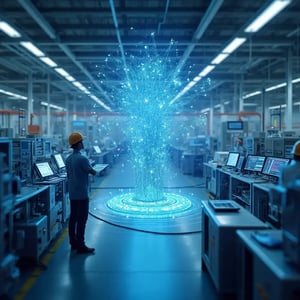 Real-time connectivity
Connect with MES & IoT for real-time digital twin updates that reflect current production conditions.
 Resource optimization
Optimize future resource utilization through APS simulation to maximize productivity and minimize costs.
 System visualization
Visualize complete production system dynamics to identify bottlenecks and improvement opportunities.
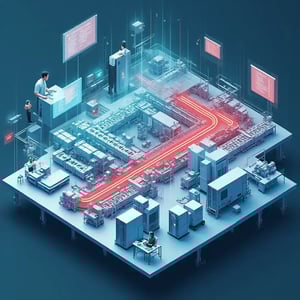 Parameter analysis
Support analysis of planning parameters through digital twin simulation to fine-tune APS configuration.
 Risk assessment
Assess APS implementation risk through intelligent digital twin virtual analysis to ensure smooth deployment and adoption.
 Pattern identification
Identify future data patterns & trends through APS simulation to proactively address emerging challenges.
 Constraint detection
Detect & address process constraints before the APS implementation to ensure feasible scheduling from day one.
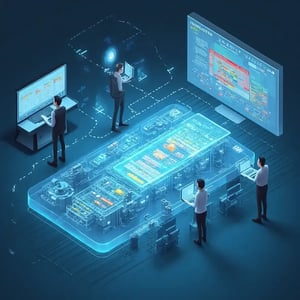 Schedule generation
Create operational production schedules based on digital twin simulation that balance all constraints and business objectives across all timelines..
Simio APS in Action
Initiatives
Example Results