

Digital Twin Automotive Solutions for Manufacturing Excellence
The automotive industry faces unprecedented challenges including compressed development cycles, electric vehicle transitions, autonomous driving technologies, and global supply chain disruptions. These pressures demand new approaches to manufacturing planning and execution as traditional methods struggle to address increasing model complexity and shorter product lifecycles. Digital twin technology offers automotive manufacturers a powerful solution by creating virtual replicas of production systems that enable testing and validation before physical implementation, significantly reducing time-to-market while improving operational efficiency.
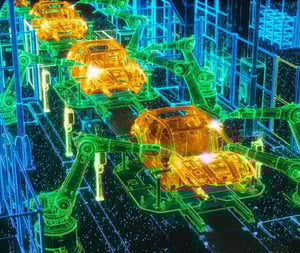
Simio’s digital twin automotive technology creates accurate virtual replicas of your entire production system, from individual assembly stations to complete manufacturing lines. This dynamic model integrates real-time data from your production floor, enabling engineers to test process changes, validate new vehicle introductions, and optimize assembly sequences without disrupting actual operations. The technology seamlessly connects with existing manufacturing systems to create a comprehensive digital environment where teams can identify constraints, monitor production performance, validate process changes virtually, and predict potential bottlenecks before they impact physical operations.
Beyond the factory floor, digital twin applications extend to supplier networks, logistics operations, and distribution systems, creating an end-to-end virtual representation of the automotive value chain. This comprehensive approach enables manufacturers to optimize material flows, reduce inventory costs, and improve overall system performance while maintaining production quality. The integration with advanced analytics represents the next evolution in automotive manufacturing excellence, enabling predictive capabilities that enhance operational efficiency while creating more resilient, flexible operations that can quickly adapt to market demands and supply chain fluctuations.
Discrete Event Simulation: Precision Modeling for Manufacturing Systems
Automotive manufacturing represents one of the most complex production environments with thousands of components, multiple vehicle variants, and stringent quality requirements that demand precision modeling beyond static planning tools. Simio’s automotive discrete event simulation accounts for these industry-specific challenges while enabling manufacturers to validate changes virtually before physical implementation.
Vehicle production systems require specialized simulation capabilities that can accurately model mixed-model assembly lines, complex robotic processes, and just-in-time component delivery across global supply networks. Our simulation platform integrates seamlessly with existing automotive design and manufacturing systems to create a comprehensive digital environment where production teams can optimize operations without disrupting actual production.
The simulation captures critical automotive manufacturing variables including:
Our platform models the intricate differences between multiple vehicle models and trim levels running on the same production line. This capability allows manufacturers to optimize mixed-model sequencing and balance workloads across stations regardless of product mix variations.
The simulation accurately represents the complex sequence of tooling changes, reprogramming, and material swaps required between different vehicle models. These insights enable planning teams to minimize downtime during transitions while maintaining production quality across model changes.
Our software precisely models the rhythm of automotive assembly lines including station-specific cycle times and their impact on overall line balance. This analysis helps identify opportunities to synchronize operations and eliminate costly waiting time between processes.
The simulation models the precise timing of component arrivals from suppliers to assembly points throughout the production process. This capability ensures optimal inventory levels while preventing costly line stoppages due to missing parts or excessive work-in-process.
Our platform accurately represents automated welding, painting, and assembly operations including robot path planning and cycle time optimization. These simulations help engineers identify interference issues and optimize robot utilization across the production environment.
The software models strategic quality checkpoints throughout the assembly process including automated vision systems and manual inspection stations. This comprehensive approach helps quality teams optimize sampling strategies and minimize defects reaching final assembly.
Our simulation incorporates scheduled maintenance activities and their impact on production capacity across different timeframes. This capability allows maintenance and production teams to coordinate activities for minimal disruption while maintaining equipment reliability.
The platform models specialized processes for battery assembly, testing, and integration unique to electric vehicle manufacturing. This functionality helps traditional manufacturers plan efficient transitions from conventional to electric vehicle production while optimizing new process flows.
Advanced Planning and Scheduling for Automotive Production
Automotive production scheduling requires balancing multiple competing priorities while adapting to constant change. Simio’s Advanced Planning and Scheduling (APS) system integrates with your digital twin to generate feasible, optimized production schedules.
Automotive engineering simulation helps identify potential issues before they impact production, allowing planners to proactively address constraints. Our APS system connects with your existing MES and ERP systems, incorporating real-time data to create schedules that reflect current plant conditions.
The system enables planners to:
- Coordinate specialized equipment: Schedule critical body shop and final assembly resources to maximize throughput without creating bottlenecks or starving downstream operations.
- Manage skilled technician allocation: Ensure certified technicians are assigned to specialized operations including electrical system installation and complex subassemblies.
- Balance workstation loading: Distribute model-specific work content across stations to maintain consistent takt time regardless of production mix variations.
- Provide multi-dimensional schedule views: Enable stakeholders to analyze production plans by model, option content, supplier impact, and resource utilization simultaneously.
- Simulate schedule modifications: Test the impact of potential changes before implementation to avoid unintended consequences across the manufacturing system.
- Facilitate cross-functional coordination: Connect production control, maintenance, logistics, and quality teams through a unified scheduling platform.
- Orchestrate just-in-sequence deliveries: Coordinate component arrival timing to match exact vehicle build sequence requirements across multiple supplier tiers.
- Manage component availability constraints: Incorporate parts shortages and allocation priorities into production schedules to minimize line disruptions.
- Optimize inbound logistics: Schedule dock appointments and material movements to ensure smooth flow of components from receiving to point-of-use locations.
- Respond to unplanned events: Quickly generate recovery options when equipment failures, quality holds, or supply disruptions impact planned production.
- Prioritize build sequence recovery: Intelligently resequence production after disruptions to minimize impact on high-priority vehicles and customer commitments.
- Maintain supplier alignment: Automatically notify affected suppliers when schedule changes occur to ensure synchronized material flow throughout recovery.
- Minimize paint shop transitions: Reduce costly color changeovers and solvent usage by grouping similar paint colors while maintaining overall production mix requirements.
- Balance option content: Distribute high-option vehicles across the production schedule to prevent workstation overloading and maintain consistent line speed.
- Optimize model mix sequencing: Calculate ideal spacing between different vehicle models to minimize tooling changes and maximize production efficiency across the assembly line.
Unlike traditional scheduling methods, Simio’s digital twin planning seamlessly integrates with MES and ERP systems to generate actionable production schedules that reflect real-time factory conditions and operational timelines, enabling practical plans that minimize rush costs and enhance on-time delivery in the automotive industry.
Inventory Optimization with DDMRP Simulation
Automotive supply chains face unprecedented complexity with thousands of components, just-in-sequence delivery requirements, and global sourcing networks spanning multiple tiers of suppliers. Simio’s DDMRP simulation helps manufacturers optimize inventory positioning and buffer sizes throughout their supply network, addressing the unique challenges of automotive production where a single missing component can halt an entire assembly line.
Digital twin technology enables automotive manufacturers to test inventory strategies virtually before physical implementation, significantly reducing implementation risk while maximizing performance. Our DDMRP simulation platform integrates with existing ERP and MES systems to create a comprehensive testing environment where planners can validate buffer strategies against actual production data and historical demand patterns.
- Optimize strategic inventory positioning: Identify critical decoupling points across the bill of materials to protect production flow while minimizing total inventory investment. Our simulation pinpoints optimal buffer locations based on component criticality, lead time variability, and impact on final assembly operations.
- Validate buffer profiles: Test various buffer zone sizes and adjustment factors to determine optimal inventory levels for each part category. The simulation evaluates different buffer configurations against historical demand patterns and production schedules to identify the most efficient profile for each component class.
- Implement dynamic adjustments: Simulate seasonal and market-driven buffer adjustments to balance inventory levels with changing demand patterns. Our platform models how buffer levels should automatically adapt to production volume changes, new model introductions, and shifting market preferences across your vehicle portfolio.
- Test replenishment strategies: Compare various order generation approaches and their impact on service levels, inventory turns, and production stability. The simulation evaluates different replenishment rules against actual supplier performance data to identify optimal ordering patterns for each component category.
- Analyze lead time variability: Quantify how fluctuations in supplier and production lead times affect buffer effectiveness and required safety stock levels. Our platform models the impact of lead time variations from global suppliers, allowing planners to establish appropriate buffer levels that maintain production continuity without excessive inventory.
- Optimize order quantities: Determine ideal replenishment sizes that balance ordering costs with inventory carrying costs across the supply chain. The simulation calculates optimal order quantities based on component characteristics, supplier constraints, and transportation considerations specific to automotive logistics networks.
- Simulate supply chain disruptions: Test buffer effectiveness during supplier failures, transportation delays, and demand spikes to validate system resilience. Our platform allows manufacturers to model the impact of real-world disruptions on production continuity and evaluate how different buffer strategies perform under stress conditions.
- Quantify working capital requirements: Calculate precise inventory investment needed to support DDMRP implementation across various service level targets. The simulation provides detailed financial analysis of buffer requirements, helping finance and operations teams align on the optimal balance between service levels and working capital allocation.
- Evaluate recovery scenarios: Assess how quickly the system recovers from disruptions under different buffer management strategies and replenishment rules. Our platform measures recovery time and production impact following simulated disruptions, helping manufacturers develop robust contingency plans that minimize downtime and customer impact.
.webp "Intelligent-Digital-Twin-Difference-in-DDMRP (1)")
Unlike traditional inventory planning methods, Simio’s digital twin approach enables automotive manufacturers to validate DDMRP implementation virtually before physical deployment, reducing implementation risk while maximizing performance gains. Our customers typically achieve 15-30% inventory reduction while maintaining or improving service levels, creating a significant competitive advantage in an industry where both capital efficiency and production continuity are critical success factors.
Core Automotive Applications
Simio’s digital twin technology delivers value across multiple automotive manufacturing applications:
- Facility Layout Optimization: Test different equipment arrangements to minimize transport distances
- Material Flow Analysis: Identify and eliminate crossing paths and congestion points
- Workstation Design: Optimize individual stations for ergonomics and efficiency
- Expansion Planning: Validate capacity additions and reconfigurations before capital commitment
- Production Impact Analysis: Assess how new models affect existing production
- Tooling and Equipment Validation: Verify that planned resources can meet quality and volume targets
- Ramp-Up Strategy: Develop optimal transition plans from current to future production
- Risk Assessment: Identify potential issues before they impact launch timing
- Bottleneck Analysis: Identify and quantify production constraints across your manufacturing system
- Improvement Validation: Test proposed changes to verify throughput improvements before implementation
- Capacity Planning: Determine true production capacity accounting for product mix and variability
- Resource Utilization: Optimize equipment and labor allocation to maximize throughput
- Quality Checkpoint Optimization: Identify optimal inspection locations to maximize defect detection while minimizing resource requirements
- Sampling Strategy Validation: Test quality inspection sampling approaches to ensure statistical validity with minimal production impact
- Process Variability Analysis: Model how manufacturing variations affect quality outcomes to identify improvement opportunities
- Defect Propagation Modeling: Trace how early-stage quality issues impact downstream processes and final product quality
- Battery Manufacturing Simulation: Model specialized processes for battery production
- Assembly Line Conversion: Plan efficient transitions from ICE to EV production
- Charging Infrastructure: Optimize in-plant charging systems for AGVs and test vehicles
- New Process Validation: Test novel manufacturing methods required for EV component
- Automated Material Handling: Optimize AGV routes and charging strategies
- Collaborative Robot Implementation: Validate human-robot interaction scenarios
- Vision System Placement: Optimize sensor locations for quality inspection
- Safety Protocol Verification: Ensure automated systems operate safely alongside worker
Implementation Methodology for Automotive Success
Our structured implementation approach ensures successful deployment of digital twin technology in automotive environments:
- Constraint Documentation: Apply Advanced Product Quality Planning (APQP) methodology to systematically identify and document current system constraints
- Performance Metrics: Define clear KPIs aligned with automotive industry standards including Overall Equipment Effectiveness (OEE), First Time Through (FTT), and Production Part Approval Process (PPAP) requirements
- Process Mapping: Document current production processes using standardized automotive Value Stream Mapping (VSM) techniques
- Data Requirements: Identify necessary data sources across Manufacturing Execution Systems (MES), quality systems, and supplier interfaces for accurate modeling
- Data Source Identification: Locate required information across plant systems including Supervisory Control and Data Acquisition (SCADA), Manufacturing Execution Systems (MES), and quality management databases
- Data Quality Assessment: Evaluate data integrity using automotive-specific validation techniques including Gage Repeatability & Reproducibility (GR&R) studies
- Integration Planning: Develop connections to manufacturing systems following International Automotive Task Force (IATF) 16949 data management principles
- Data Transformation: Create Extract, Transform, Load (ETL) processes optimized for high-volume automotive production data
- Process Logic Modeling: Accurately capture production rules including Just-in-Time/Just-in-Sequence (JIT/JIS) sequencing and mixed-model assembly constraints
- Resource Detail: Model equipment capabilities including Original Equipment Manufacturer (OEM)-specific tooling constraints and ergonomic requirements
- Material Flow: Represent physical movement systems including Automated Guided Vehicles (AGVs), conveyors, and kitting operations
- Validation: Verify model accuracy using Failure Mode and Effects Analysis (FMEA) methodology to identify potential failure points
- Constraint Analysis: Apply Theory of Constraints (TOC) methodology to identify and quantify system bottlenecks
- Scenario Testing: Evaluate improvement alternatives against automotive takt time requirements
- Scheduling Optimization: Develop optimized sequencing rules that minimize paint shop and trim line changeovers
- Implementation Planning: Create detailed roadmap aligned with production launch milestones and supplier readiness
- Schedule Execution: Connect simulation to daily production planning using Single-Minute Exchange of Die (SMED) principles for efficient implementation
- Performance Monitoring: Track actual vs. simulated results using automotive-standard andon systems
- Continuous Refinement: Update model as processes evolve using structured Eight Disciplines (8D) problem-solving methodology
- Knowledge Transfer: Train team members following Training Within Industry (TWI) principles for sustainable implementation
Frequently Asked Questions
Automotive simulation software creates virtual models of vehicle manufacturing processes to test changes, optimize production, and solve problems without disrupting actual operations. Simio’s solution combines discrete event simulation with digital twin technology to provide accurate, dynamic representations of your entire production system.
Digital twin in automotive industry applications provides a virtual replica of your production system that updates in real-time with operational data. This allows manufacturers to test process changes virtually, identify constraints, optimize scheduling, and improve overall system performance without risking disruption to actual production.
Yes, Simio’s automotive simulation software is designed to integrate with your existing MES, ERP, PLM, and other manufacturing systems. Our implementation methodology includes establishing data pipelines from your current systems to ensure the digital twin accurately reflects your actual production environment.
Implementation timelines vary based on system complexity and data availability, but typical projects deliver initial value within 8-12 weeks. Our structured methodology ensures rapid development of an accurate model, with continuous refinement as more data becomes available and as your production system evolves.
Automotive digital twin technology from Simio combines discrete event simulation with real-time data integration and advanced analytics. Unlike static planning tools or simplified simulation packages, our solution captures the complex dynamics of automotive production, including variability, constraints, and interdependencies across your entire manufacturing system.
Yes, vehicle simulation software from Simio can model your current production system while also supporting “what-if” analysis for future scenarios. This capability is particularly valuable for new product introduction planning, facility expansions, and production system reconfigurations.
Our automotive engineering simulation capabilities include specialized features for electric vehicle production, including battery manufacturing processes, new assembly techniques, and integration of automated systems. The simulation can help manufacturers plan efficient transitions from traditional to electric vehicle production.