

77% Security Footprint Reduction: Venues have dramatically decreased the space required for security screening while maintaining or improving safety protocols, freeing valuable real estate for revenue-generating activities.
Transform Your Operations with Intelligent Digital Twin Simulation
Quantify risk with precision, optimize with confidence— simulate what-if scenarios with an Intelligent Digital Twin powered by Simio Discrete Event Simulation
Next-Generation Stadium Management: Digital Twin Innovation
Revolutionize your venue operations with Simio’s Digital Twin technology—giving stadium operators the power to test operational changes virtually before implementation, make data-driven decisions that enhance both fan satisfaction and bottom-line results, and position your venue for success in the smart stadium market that is projected to reach $38 billion by 2033.
Navigating Complex Stadium Management Challenges
Today’s stadium operators face unprecedented operational complexity in an increasingly competitive landscape. Modern venues must process tens of thousands of visitors within narrow time windows while balancing contradictory demands: thorough security versus rapid entry, efficient staffing versus peak-period coverage, and maximized concession revenue versus minimized wait times.
Security operations and concession management directly impact both fan experience and financial performance. Entry points must process thousands of fans while maintaining safety standards and reasonable wait times, while concession areas often create bottlenecks during peak periods. Studies show nearly 95% of fans miss portions of events while waiting in line, diminishing the experience and limiting revenue potential.
Resource allocation decisions must typically be made with limited visibility into outcomes. Stadium operators frequently ask:
- How many security checkpoints should each gate have?
- How should staff be distributed across unpredictable attendance patterns?
- Which concession service model will maximize both throughput and revenue?
Without advanced analytical tools, these decisions rely primarily on educated guesswork and incremental adjustments—approaches that cannot account for the complex interplay of variables in a dynamic venue environment.
.webp?width=300&name=Heinz-Field-Model%20(1).webp)
Digital Twin Technology: The Virtual Stadium
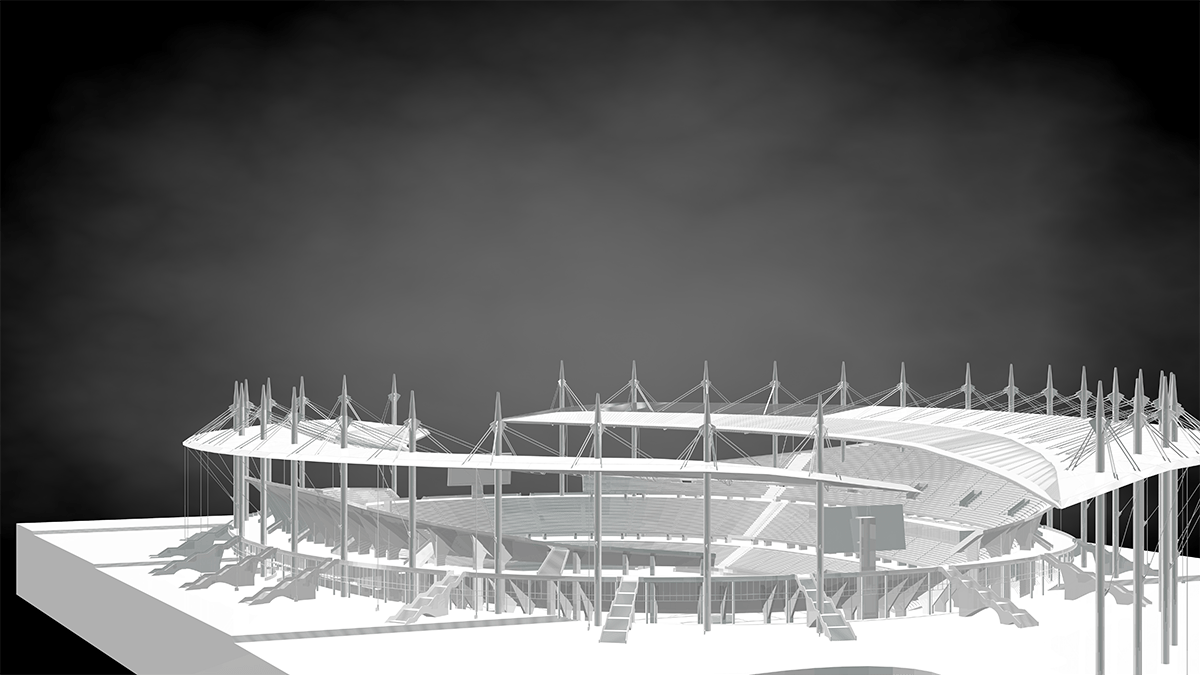
Digital twin technology creates an accurate virtual replica of your entire stadium—not just the physical structure, but the complete operational ecosystem. This advanced modeling approach processes operational data to build a dynamic digital counterpart that reflects your venue’s functioning. By mirroring every aspect of your venue’s operations, from entry gates to concession stands, digital twins provide unprecedented visibility into complex stadium environments.
Stadium operators implement digital twin technology because it effectively enables:
Transform complex venue data into clear, actionable insights. Digital twins create intuitive visual representations of crowd flow patterns, queue formations, and service utilization across your stadium, allowing managers to identify improvement opportunities that would remain hidden in spreadsheets or reports.
Identify potential issues before they impact fan experience. By analyzing patterns in historical and current data, digital twins can forecast bottlenecks, staffing shortages, and other operational challenges with remarkable accuracy.
Validate operational changes before real-world implementation. Stadium managers can test new security configurations, concession layouts, or staffing models in the digital environment, eliminating the risk and disruption of trial-and-error approaches.
Allocate staff and assets precisely where and when they’re needed. Digital twins analyze attendance patterns, entry rates, and concession demand to determine optimal resource distribution, reducing costs while improving service levels.
Minimize wait times and maximize enjoyment throughout the venue. By optimizing security screening, concession operations, and crowd flow, digital twins help ensure fans spend more time enjoying events and less time standing in lines.
Prepare for and manage unexpected situations with confidence. Digital twins enable testing of various emergency scenarios, helping venue operators develop and refine response protocols without disrupting normal operations.
Replace guesswork with quantifiable insights for operational improvements. Stadium digital twins transform complex operational data into clear visualizations and actionable recommendations, enabling managers to make confident decisions based on comprehensive analysis.
Discrete Event Simulation: The Analytical Engine Behind Stadium Excellence
Discrete Event Simulation (DES) serves as the analytical powerhouse that transforms stadium digital twins from static models into dynamic decision-making tools. This sophisticated modeling approach breaks down complex venue operations into individual events—from security screenings to concession transactions—enabling stadium operators to test operational changes virtually and implement only the most effective solutions.
- Process-Based Modeling: DES analyzes stadium operations as sequences of distinct events occurring at specific points in time, creating accurate representations of complex processes like entry procedures, concession operations, and crowd movement.
- Real-World Event Capture: The technology models actual stadium events such as fans arriving at security checkpoints, concession orders being placed, or groups moving through concourses—providing insights into how these interactions affect overall venue performance.
- Statistical Analysis: DES incorporates variability and randomness that exist in real stadium environments, accounting for fluctuations in arrival rates, service times, and crowd behavior to deliver statistically valid predictions.
- Time-Based Insights: Unlike static analysis tools, DES advances a virtual clock to track how stadium operations unfold over time, revealing bottlenecks and inefficiencies that would remain hidden in spreadsheet-based planning.
- Risk-Free Experimentation: Stadium managers can test operational changes virtually before implementation, eliminating the disruption and potential negative impacts of trial-and-error approaches during live events.
- Resource Optimization: DES identifies the optimal allocation of staff, security checkpoints, and concession stations across your venue, reducing costs while maintaining or improving service levels.
- Bottleneck Identification: The technology pinpoints congestion areas in entry points, concourses, and service areas that impact fan experience, allowing for targeted improvements where they matter most.
- Capacity Planning: Stadium operators can determine the ideal capacity for different venue areas and services, ensuring facilities can handle peak demand without unnecessary overcapacity during normal operations.
- What-If Analysis: DES enables testing of various scenarios—from weather impacts to special promotions—helping venues prepare for different conditions and optimize operations accordingly.
- Dynamic Data Integration: DES transforms static venue models into living digital twins by incorporating operational data and real-world variables that affect stadium performance.
- Predictive Capabilities: The technology enables digital twins to forecast outcomes of operational changes, helping stadium managers anticipate issues before they impact fan experience.
- Continuous Improvement: DES powers the iterative optimization process, allowing digital twins to evolve and improve as new data becomes available and operational requirements change.
- Visual Decision Support: Simulation results are presented through intuitive visualizations that help stakeholders understand complex operational dynamics and support confident decision-making.
- Intuitive Modeling Environment: Simio’s drag-and-drop interface and pre-built object libraries allow stadium teams to build sophisticated simulations without extensive programming knowledge.
- Intelligent Objects Technology: Our patented approach uses smart objects that understand how to interact with other elements in the stadium environment, creating more realistic and accurate simulations.
- Powerful Scenario Testing: Simio enables operators to run thousands of scenarios quickly, identifying optimal configurations for security, concessions, and crowd management with statistical confidence.
- Superior Visualization: Our platform offers both 2D and 3D visualization of simulation results, helping stakeholders visualize operational changes and their impacts throughout the venue.
- Proven Stadium Expertise: Simio has helped major venues achieve measurable improvements, including 30% reductions in entry wait times and 77% reductions in security screening footprints while maintaining safety standards.

Measurable Benefits and ROI
Stadium operators implementing digital twin and simulation technologies achieve quantifiable returns across multiple operational dimensions. These solutions deliver both immediate operational improvements and long-term strategic advantages, with documented results from venues across professional and collegiate sports showing consistent, measurable value creation.
Simulation models help venues maximize the effectiveness of limited space while maintaining security and service standards.
Strategic Concession Placement: Digital twins identify optimal locations for food and beverage services based on crowd flow patterns, increasing accessibility while reducing congestion in high-traffic areas.
When fans spend less time in lines and more time enjoying the venue, operators see direct financial benefits across multiple revenue channels.
15-20% Higher Concession Sales: By reducing service times from 6+ minutes to under 2 minutes, venues capture sales that would otherwise be lost, with significant increases in per-capita spending.
Increased Premium Offering Uptake: Optimized venues report higher sales of premium food and beverage items as fans have more time to explore options rather than grabbing the quickest available choice.
Data-driven resource allocation enables venues to maintain or improve service levels while significantly reducing operational expenses.
10-15% Lower Staffing Costs: Simulation-optimized staff deployment ensures personnel are allocated precisely where and when needed, eliminating overstaffing while maintaining service quality.
Reduced Training Expenses: Virtual testing of operational procedures allows staff to be trained more efficiently on optimized processes, reducing training time and associated costs.
Improved game-day experiences translate directly to higher attendance rates and increased customer lifetime value.
5-8% Higher Renewal Rates: Venues with optimized operations report significant increases in season ticket renewals as fans experience consistently superior event experiences.
Expanded Customer Base: Word-of-mouth recommendations increase as fans spend more time enjoying events and less time dealing with operational inefficiencies.
Digital twins allow venues to validate improvements virtually before committing capital, ensuring maximum return on infrastructure investments.
Virtual Validation: New technology implementations and facility upgrades can be tested in the digital environment first, preventing costly mistakes and optimizing designs before construction begins.
Phased Implementation Planning: Simulation helps identify which improvements will deliver the greatest immediate ROI, allowing for strategically sequenced implementation that maximizes financial benefits.
Simulation models help venues maximize the effectiveness of limited space while maintaining security and service standards.
77% Security Footprint Reduction: Venues have dramatically decreased the space required for security screening while maintaining or improving safety protocols, freeing valuable real estate for revenue-generating activities.
Strategic Concession Placement: Digital twins identify optimal locations for food and beverage services based on crowd flow patterns, increasing accessibility while reducing congestion in high-traffic areas.
Stadium Digital Twins in Action: Real-World Success Stories
Entry Security Optimization
Digital twin simulation at a major sports venue optimized security across multiple entry gates, reducing wait times by 30% while decreasing security screening footprint by 77%—all without compromising safety protocols.
Concession Service Transformation
A professional venue evaluated three concession models through simulation, reducing service times from 6+ minutes to under 2 minutes. Fans missing event action decreased from 95% to 16%, boosting concession revenue by 15-20%.
Crowd Flow Enhancement
Venue operators now visualize how attendees navigate facilities, identifying congestion points, optimizing pathways, and testing emergency procedures virtually—enhancing both safety and the overall guest experience.
Implementation Approach: Building Your Digital Stadium
Implementing a digital twin stadium solution enables operators to visualize and optimize every aspect of venue operations. Simio’s approach to digital twin implementation follows a structured methodology:
The first step involves analyzing your venue’s current operations and identifying key data sources, including:
- Architectural Blueprints: Access detailed venue layouts and CAD drawings to create accurate spatial representations within the digital environment
- Attendance Analytics: Integrate historical attendance patterns and demographic data to model realistic crowd behaviors and flow dynamics
- Security Protocols: Incorporate comprehensive security screening data to optimize checkpoint configurations while maintaining safety standards
- Revenue Insights: Leverage concession sales information to identify high-traffic areas and optimize service point placement
- Workforce Distribution: Analyze staff deployment records to determine optimal personnel allocation across venue operations
Using Simio’s intuitive modeling environment, we create a comprehensive digital twin that accurately represents your venue’s operations:
- Object-Oriented Modeling: Build sophisticated simulations without extensive programming knowledge
- Pre-Built Libraries: Access stadium-specific object libraries and intelligent objects
- Intuitive Interface: Utilize drag-and-drop functionality for rapid model development
Once the digital twin is operational, we help you explore optimization opportunities:
- What-If Analysis: Test various operational configurations
- Stress Testing: Evaluate performance under peak conditions
- Optimization Tools: Automatically identify optimal resource allocation
The insights gained through simulation drive real-world improvements:
- Data-Driven Decisions: Implement changes based on validated simulation results
- Measurable Outcomes: Track performance improvements against baseline metrics
- Ongoing Optimization: Continuously refine operations as new data becomes available
Frequently Asked Questions
A digital twin is a dynamic virtual replica of your entire stadium ecosystem—not just the physical structure, but all operational components. It processes data from various sources to create an accurate digital counterpart that mirrors how your venue functions, from entry gates to concession stands, enabling testing and optimization without disrupting live events.
Unlike spreadsheets or static models, stadium digital twins incorporate real-time data and variability to simulate actual operations as they unfold over time. They account for the complex interactions between different stadium systems and the randomness inherent in crowd behavior, providing dynamic insights rather than fixed projections.h
Digital twins can model virtually all stadium operations, including security screening processes, concession services, crowd movement through concourses, seating area access, emergency evacuations, parking logistics, staff deployment, and special event configurations.
Creating an effective digital twin typically requires architectural layouts, historical attendance data, security screening metrics, concession sales information, staff deployment records, event schedules, and ideally, some crowd flow measurements. However, Simio can work with whatever data you currently have available and help identify additional data collection needs.
Implementation timelines vary based on venue complexity and data availability, but most stadium digital twin projects can be operational within 2-3 months. Initial models can often be developed in as little as 4-6 weeks, with refinement continuing as more data becomes available.
No. Simio’s platform is designed with user-friendly interfaces that allow venue operations staff to run scenarios and analyze results without specialized programming knowledge. Our implementation includes training for your team and ongoing support as needed.
Venues implementing digital twins typically see 30% faster entry processing, 15-20% higher concession sales, 10-15% lower staffing costs, and 5-8% higher season ticket renewal rates. The exact ROI depends on your venue’s specific challenges and opportunities, which we can help assess during initial consultation.
Many venues see immediate operational improvements after implementing their first optimization recommendations, often within the first event cycle. More comprehensive benefits typically accumulate over 3-6 months as multiple systems are optimized and staff become proficient with the new operational approaches.
Digital twins directly enhance fan experience by reducing wait times at entry points and concessions (studies show up to 80% reduction in missed event action), optimizing crowd flow to reduce congestion, improving service delivery, and enabling more personalized experiences through better resource allocation.
Digital twin technology is transforming operations across the sports and entertainment landscape, extending beyond individual venues to entire events and competitions. The Paris 2024 Olympic and Paralympic Games represents a landmark implementation, with digital twins created for all competition venues, 900+ users accessing the platform, and 60,000 objects placed and managed. Other notable applications include the Tour de France using digital twins for real-time route management and fan engagement, The Open Golf leveraging the technology for performance analysis and viewer experience enhancement, and major league sports teams creating comprehensive operational models of their facilities. As the smart stadium market grows toward its projected $38 billion value by 2033, digital twins are becoming essential tools for venue operators seeking competitive advantage.

