

Elevating Optimization Performance with AI
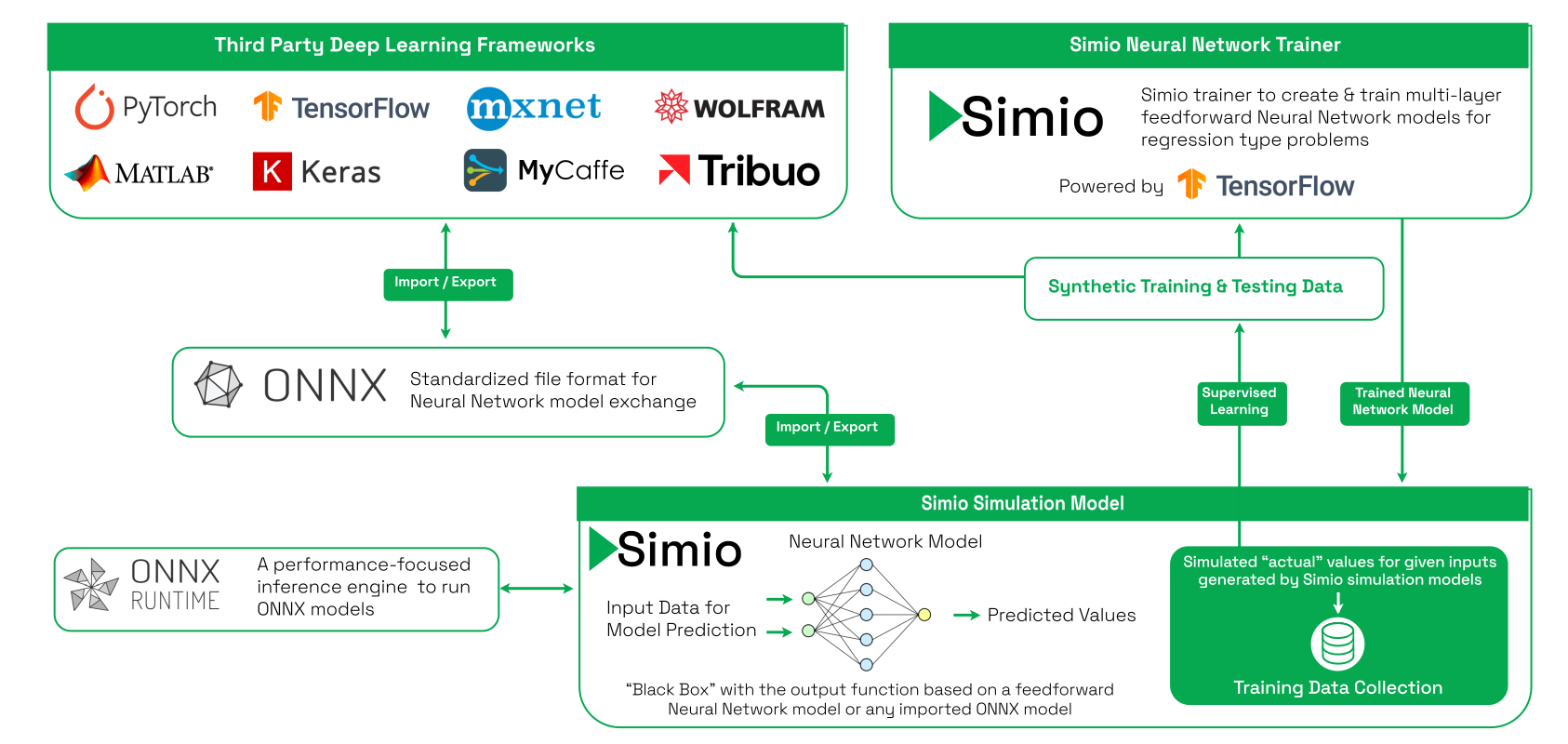
Simio is the first Discrete-Event-Based Digital Twin Simulation software company to offer native, embedded support for Neural Networks. Our internally developed support for this powerful AI-based optimization approach requires no coding and is directly integrated into Simio’s simulation engine, eliminating the need for external third-party applications. Our comprehensive support for Neural Networks includes the ability to define and use Neural Networks for inference directly within the logic of Simio Process Digital Twin models, as well as the capability to automatically capture synthetic training data from Simio models using built-in data collection features and the Neural Networks Trainer powered by TensorFlow. Simio supports the import and execution of third-party AI models using the industry-standard ONNX inference engine, and the Simio training data collection features can also be used to generate and export synthetic training data for use with third-party AI tools.
Why Combine Discrete Event Simulation with NVIDIA Omniverse?
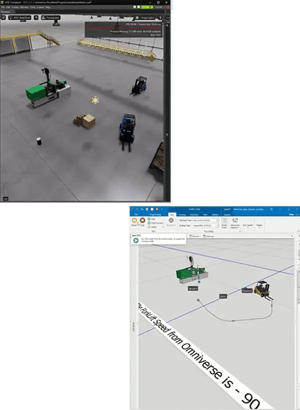
The integration of Simio’s Discrete Event Simulation with NVIDIA Omniverse creates a powerful synergy that addresses the fundamental challenge facing digital twins: balancing analytical precision with intuitive understanding. While simulation provides the mathematical foundation for accurate operational modeling—capturing complex system dynamics, variability, and interdependencies with statistical precision—Omniverse transforms abstract data into intuitive visual representations that reveal spatial relationships and physical constraints impossible to discern from numbers alone.
This combination delivers comprehensive operational intelligence by compressing time while maintaining spatial awareness. Simio’s technology accelerates time, allowing organizations to evaluate months of operational performance in minutes, while Omniverse adds crucial spatial context by accurately representing physical environments and movement constraints. Together, they ensure optimized solutions work not just theoretically but in actual operational environments with real physical constraints.
The integration bridges the communication gap between simulation experts and decision-makers by pairing statistical insights with compelling visual narratives. Complex concepts become accessible to stakeholders regardless of technical background, building consensus around improvement initiatives through both rigorous analytical evidence and intuitive visual demonstrations. This communication advantage significantly accelerates implementation and adoption of optimized solutions.
Organizations implementing this combined approach typically experience faster project approval, more efficient implementation, and greater sustained adoption of optimization initiatives. The integration delivers ROI through multiple complementary pathways: the quantifiable benefits of improved throughput and resource utilization from simulation, enhanced by accelerated stakeholder alignment and reduced redesign costs through early visual identification of potential issues. This comprehensive approach creates digital twins that drive measurable value across all stages of operational improvement.
Key Features
- Embed AI agents to capture complex decision logic, simplify models, and optimize operational processes to improve the performance of your system.
- Execute AI agents during runtime to make optimized resource selection decisions within each facility model based on the current state.
- Manufacturing application example: Predict job completion times accurately across all production lines.
- Optimize supply chain sourcing decisions using AI-predicted production lead times and costs for each candidate factory, taking into account the loading and product mix at each workstation within the factory.
- This AI-based approach eliminates the need for assuming static lead times, using artificial time buckets, and relying on rough-cut capacity models, as employed in traditional Master Planning systems.
- Performing optimization with embedded Neural Networks — rather than traditional process logic — within Simio Process Digital Twins, will reduce the time needed to generate optimized planning and scheduling solutions in real-world operational deployments.
- Test and validate the performance and behavior of AI algorithms prior to implementation in a no-risk virtual sandbox environment.
- Easily fine-tune the performance of AI agents by evaluating different Machine Learning configurations and hyperparameter settings.
- Simio Process Digital Twins, integrated with Machine Learning algorithms, can be used for simulations and experimentation to design and analyze operational processes. Simio Process Digital Twins can also be deployed in real-world operational scenarios to ensure optimized Planning & Scheduling solutions.
- Simio Process Digital Twin models can create clean, labeled, and fully feasible data covering the entire solution space for training AI agents.
- Embedded and external third-party Neural Networks can be trained using Simio’s built-in Gradient Descent training algorithm.
- Synthetic training data can be exported to external third-party Neural Networks for training. The trained Neural Networks can then be imported back into Simio for execution.
- When changes in operational conditions occur — such as the addition of new equipment, the introduction of new products, or changes to process flows — the Simio Process Digital Twin model can be automatically updated to reflect these changes, and new training data can be automatically created to retrain AI agents.
- When working with complex Process Digital Twins that involve numerous inputs and outputs — such as master data (input), sales forecasts (input), and multiple KPIs (outputs) — leveraging Machine Learning or other AI-based optimization approaches to fine-tune system parameters can unlock greater improvements in operational efficiency and profitability than simulation alone.
- Simio offers robust support for scaling computing power and memory to efficiently handle increased scenario replications/runs, ensuring confidence in optimized solutions.
- Using programming languages such as Python, scripts can be created to automatically generate and run replications of Simio Process Digital Twin models directed by an AI optimizer algorithm or application. Outputs can be sent back to the optimizer after each run to influence future replications.
- This approach allows Machine Learning and other advanced algorithms to tightly interact with Simio Process Digital Twins, combining the strengths of both Discrete Event Simulation and Machine Learning Optimization.
- Simio is designed from the ground up to support seamless bidirectional data integration and streamlined automation with third-party applications and programming languages such as Python, enabling tight coupling with Simio Process Digital Twins to quickly and automatically create new data and scenarios.
- This powerful methodology supports system design, workflow automation, and ongoing system optimization.
- Simio’s architecture empowers web developers and data scientists to fully leverage Process Digital Twin technology, enabling the creation of what-if and optimization scenarios that support decision-making for stakeholders across the enterprise.
Training & Testing Neural Networks
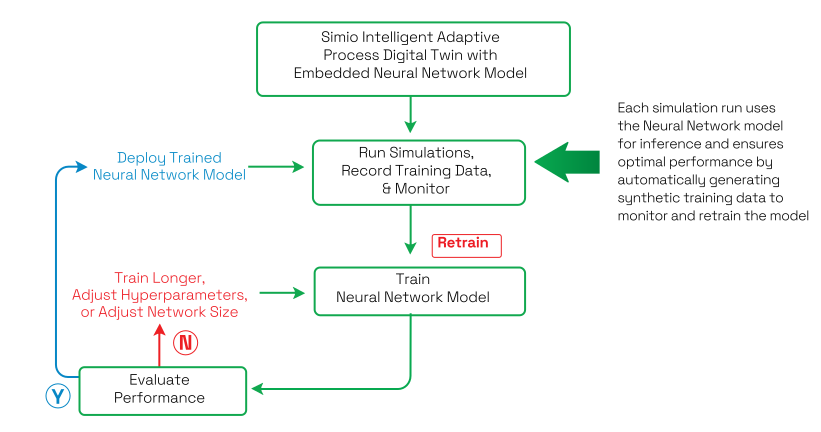
Training a Neural Network model, also known as an agent, embedded in a Simio Process Digital Twin is a straightforward process. Each Simio simulation run uses the embedded Neural Network agent for inference and ensures optimal performance by automatically generating synthetic training data to monitor and retrain the model.
- Synthetic training data recorded and saved in a training repository is used by Simio to train a feedforward Neural Network model or can be exported for training an external Neural Network model developed in a third-party application.
- Simio’s built-in trainer is powered by TensorFlow, which is one of the most popular deep learning frameworks and an open-source AI engine from Google.
- TensorFlow’s advanced training features are fully integrated into Simio, creating a seamless training process without the need to import or export data to third-party tools.
The Power of Discrete Event Simulation + AI
Combining Discrete Event Simulation and AI to address complex operational challenges in manufacturing environments and supply chains is an ideal application for this leading-edge technology. Simio’s agile platform for developing Intelligent Adaptive Process Digital Twins provides all the tools needed to train, test, and embed Deep Neural Network agents into Simio models, as well as interact bidirectionally with Machine Learning algorithms to enhance model intelligence, improve optimization results, and reduce execution run times.
 Real-Time Bi-Directional Communication
Combining Discrete Event Simulation with AI is especially valuable in Process Digital Twin applications involving Production Planning. Neural Networks can be trained to predict critical KPIs, such as dynamically changing production lead times for a single production line or an entire factory.
 Supply Chain Management Applications
End-to-End Supply Chain Management is another ideal application for Process Digital Twins, where Neural Networks can be utilized for critical supplier sourcing decisions by predicting production lead times for each candidate supplier and selecting the lowest-cost producer capable of completing the order on time.
 The Agility of Neural Networks
Neural Networks learn how changeovers, secondary resources, business rules, and other production complexities impact KPI predictions.
Eliminate Master Production Scheduling Software
AI-based factory sourcing decisions using Simio Process Digital Twins for Supply Chain applications eliminates the need for Master Production Scheduling software.