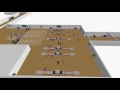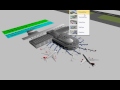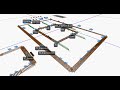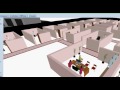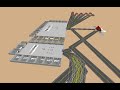
The objective of this project is to simulate a typical grocery store and its check-out process. The project includes an analysis of various configurations of self-service, fast check-out, and normal check-out lanes, and predicts a near-optimum configuration to minimize the customer wait times and maximize the server utilization.
From the results of the simulation, it can be observed that the least waiting time for customers and highest server utilizations are observed in scenario 2. However, in practice it is not a good idea because this will lead to an extremely long, but fast moving queue. It is difficult operationally to have 8 servers with just one queue and a bad design aesthetically too. Analysis of several intermediate and practical scenarios simulated in scenarios 3 through 7 are close to the ideal situation. For the set of input data assumed for this project, Scenario 7 can be recommended as it has a reasonable value for maximum and average waiting times for a customer and the server utilization. This is the scenario with 1 lane of fast checkout on RH schedule, 4 lanes of regular checkouts on WD schedule, 1 lane of regular checkout on RH schedule and 1 lane of self checkout on WD schedule. Further, it can be observed that improving this scenario to reduce the maximum waiting time of any customer by 1.03 minutes will result in 19.32% rise in operating costs.